
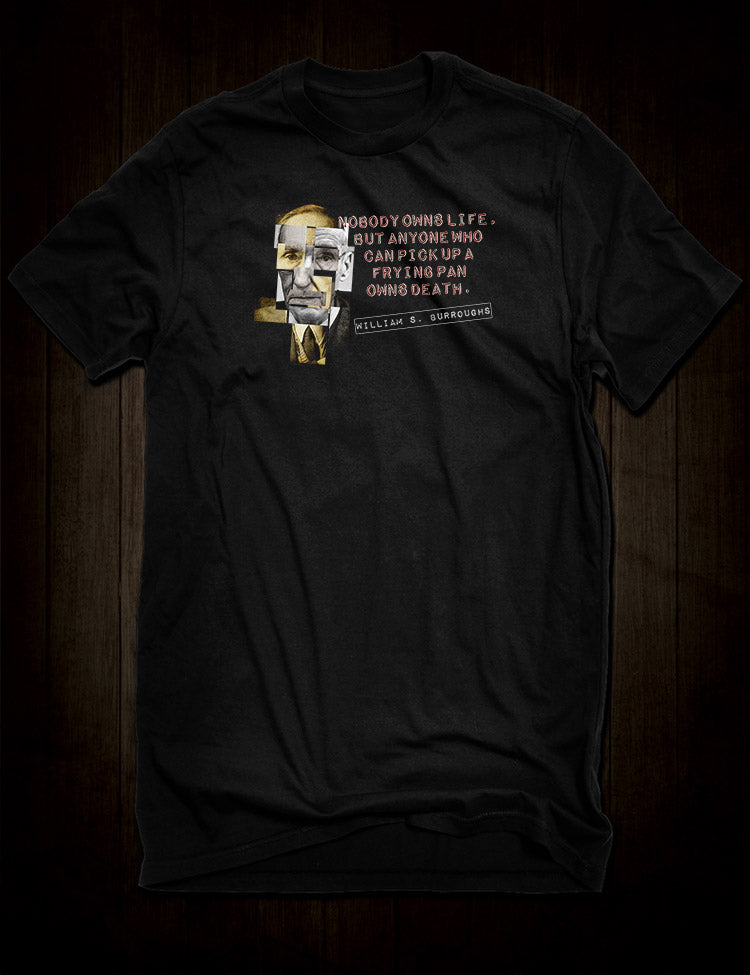


William S. Burroughs T-Shirt

WILLIAM S BURROUGHS T-SHIRT
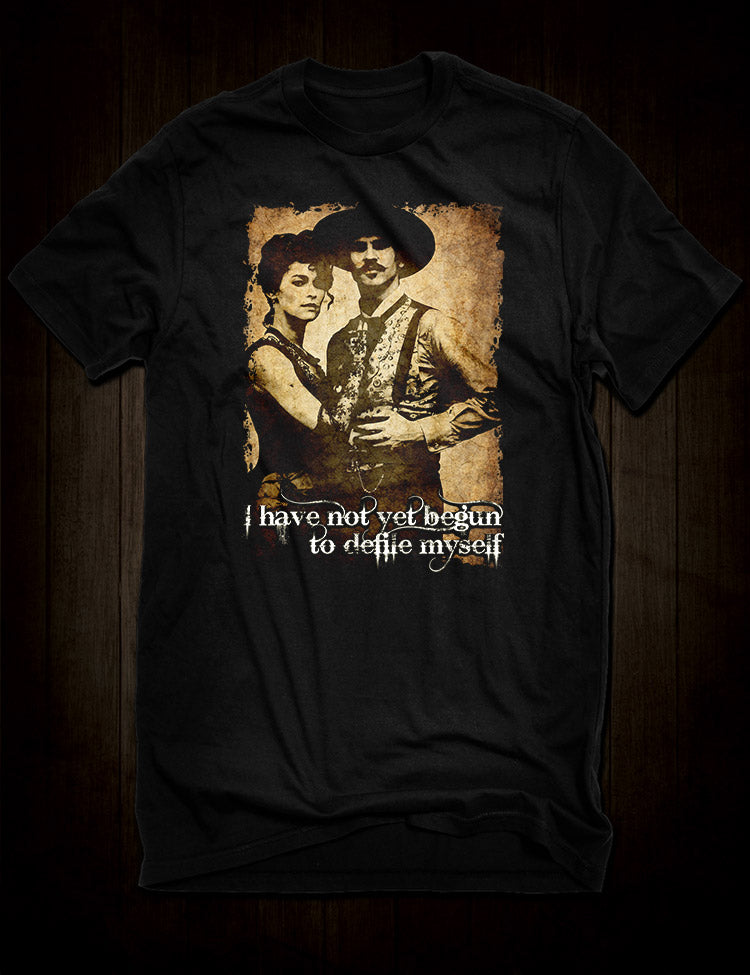
A literary t-shirt available in black cotton.
'Nobody owns life. But anyone who can pick up a frying pan owns death.'
Few writers detonated language from the inside out quite like William S. Burroughs. Novelist, cultural saboteur, and reluctant prophet of the modern age, Burroughs didn’t just write about control systems — he exposed them, sliced them open, and let the wiring hang loose. His work remains a transmission from the underside of the 20th century, still humming with danger.
Emerging alongside the Beat Generation but never fully belonging to it, Burroughs was colder, stranger, and far less sentimental than his peers. Naked Lunch, Junky, and the Nova Trilogy abandoned linear narrative in favour of fragmentation, paranoia, and brutal clarity. His cut-up technique treated language like a weaponised virus — rearranged to reveal the hidden commands buried in media, politics, advertising, and power itself.
“Language is a virus from outer space.” — William S. Burroughs
Burroughs understood something essential: that modern life is governed not by ideology alone, but by repetition, addiction, and coercion. Control, for him, wasn’t abstract — it was biological, psychological, linguistic. His obsessions with surveillance, dependency, and death read today less like provocation and more like diagnosis. Long before the internet, Burroughs grasped how systems colonise the mind.
The William S. Burroughs T-Shirt is a Hellwood tribute to that legacy. It honours a writer who refused comfort, distrusted authority, and believed that clarity required confrontation. This isn’t nostalgia. It’s literary ammunition — for readers who know that words can wound, mutate, and survive.
Cut the sentence. Break the loop. Read between the commands.
💬 FREQUENTLY ASKED QUESTIONS (FAQs)
Q1: Why is William S. Burroughs so influential?
A1: Burroughs reshaped modern literature by breaking narrative structure, exposing systems of control, and influencing generations of writers, musicians, filmmakers, and artists.
Q2: What is the cut-up technique?
A2: A literary method Burroughs popularised that involves cutting and rearranging text to disrupt linear meaning and reveal hidden patterns within language.
Q3: How does Burroughs’ work resonate today?
A3: His ideas about surveillance, addiction, media manipulation, and control feel increasingly relevant in a digital, algorithm-driven world.