
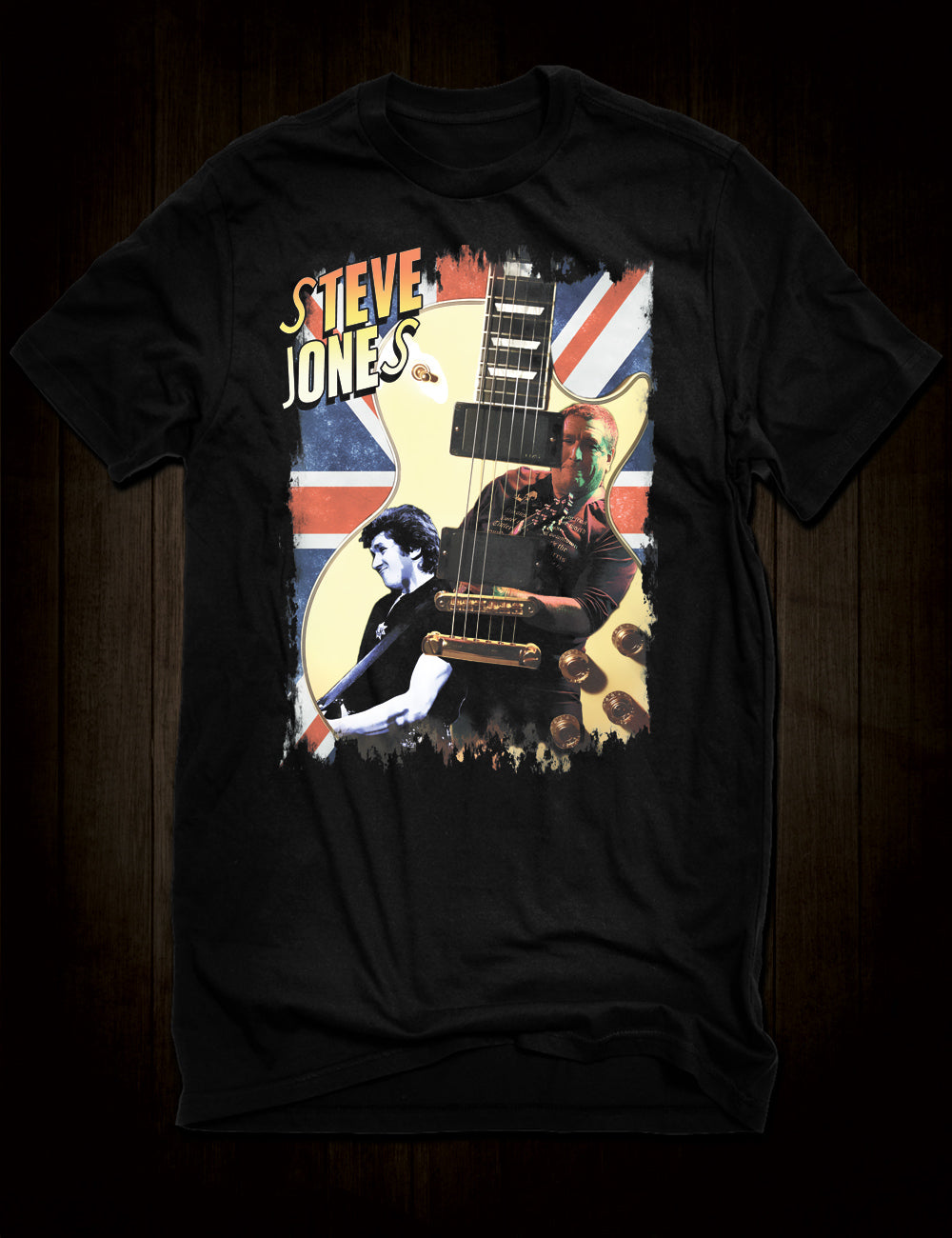
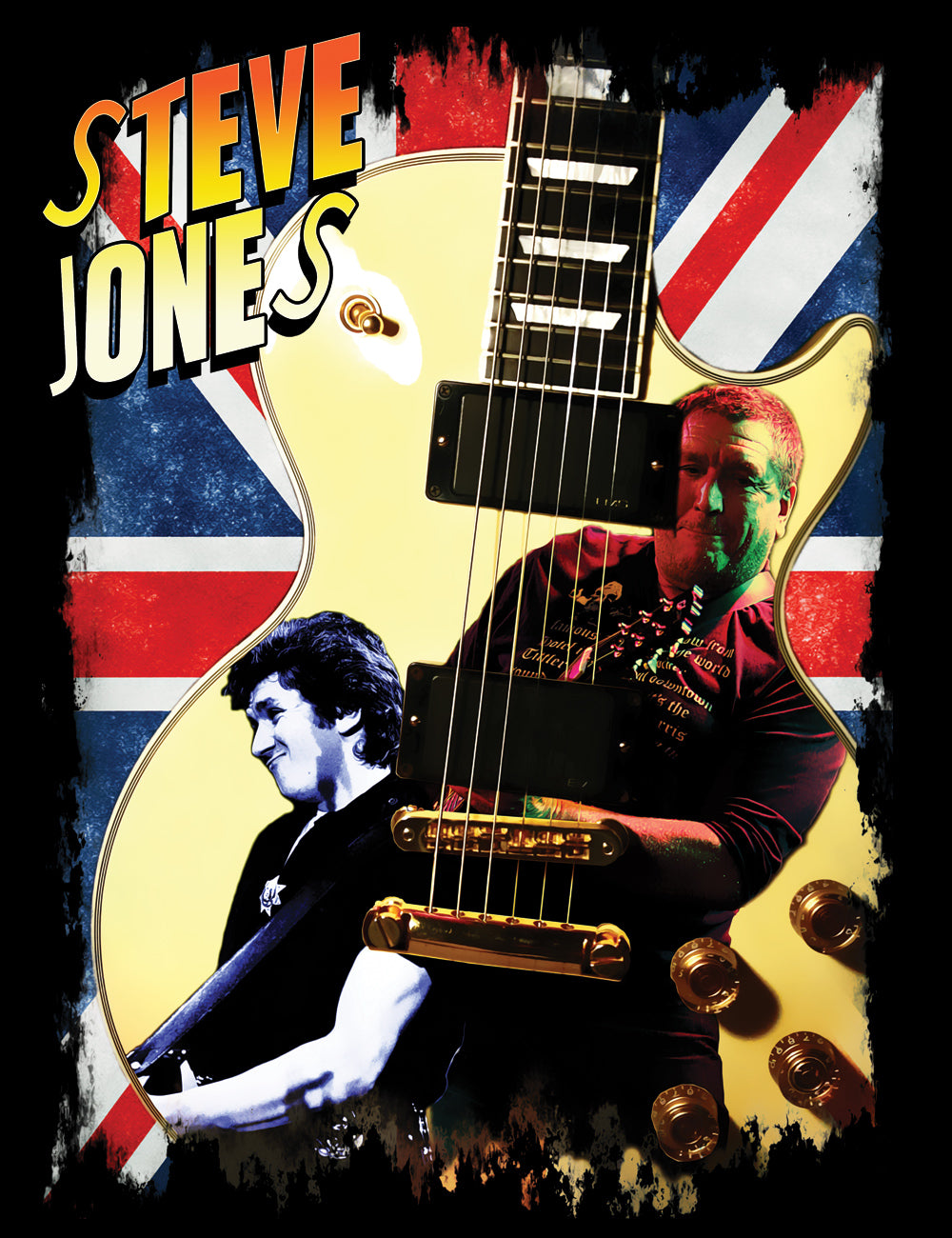
Steve Jones T-Shirt

STEVE JONES T-SHIRT
The Guitar That Gave Punk Its Teeth
Before punk became a museum exhibit, it was a guitar amplifier on the verge of surrender. Thick chords, blunt rhythmic attack and barely contained volume cut through the complacency of mid-seventies rock. At the centre of that racket was Steve Jones, whose playing supplied much of the muscle behind the Sex Pistols.
Jones helped form the band that would become the Sex Pistols, developing a guitar style that owed more to the impact of great rock and roll than to technical display. His sound was heavy, direct and remarkably assured: a wall of layered rhythm guitar that made even the group's shortest songs feel enormous.
Alongside singer John Lydon, drummer Paul Cook and the band's changing bass line-up, Jones helped turn confrontation into memorable records. Early bassist Glen Matlock contributed significantly to the songwriting; Sid Vicious later became part of the group's notoriety. Jones's guitar remained a defining constant in the music.
On Never Mind the Bollocks, Here's the Sex Pistols, producer Chris Thomas helped capture a surprisingly powerful studio sound. Beneath the group's reputation for disorder lay careful overdubbing and driving arrangements. Jones also recorded much of the bass heard on the finished album, helping create its unusually dense low-end punch.
Songs such as God Save the Queen, Pretty Vacant and Holidays in the Sun demonstrated that punk could be as memorable as it was provocative. Jones's playing did not rely on ornate solos or virtuoso complexity. It made the songs move, giving Lydon's vocals a forceful musical foundation.
The band's initial existence was brief, but its influence spread across guitar music for decades. Generations of players discovered that attitude, tone and rhythm could communicate as powerfully as elaborate technique. Jones went on to other musical projects and became familiar to radio listeners through Jonesy's Jukebox.
The Steve Jones T-Shirt celebrates one of British punk's crucial architects: a guitarist whose chords helped change the sound, look and confidence of popular music.
Three chords were never the whole story. But they were enough to start a riot of sound.
FREQUENTLY ASKED QUESTIONS (FAQs)
Did Steve Jones record bass on Never Mind the Bollocks?
Yes. Jones recorded much of the bass on the Sex Pistols' 1977 album, alongside his signature rhythm-guitar parts.
What made his guitar sound distinctive?
His layered, powerful chords and driving rhythm gave the band's recordings a dense, direct rock-and-roll force.
What is Jonesy's Jukebox?
It is the radio programme associated with Steve Jones, reflecting his extensive musical interests and distinctive presenting style.