






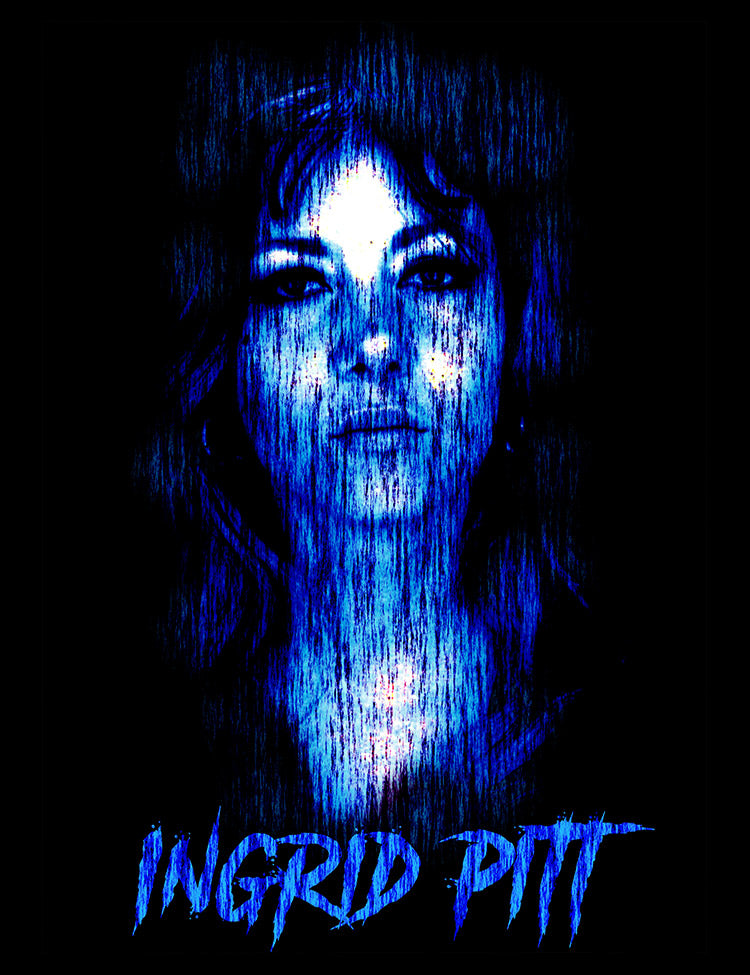
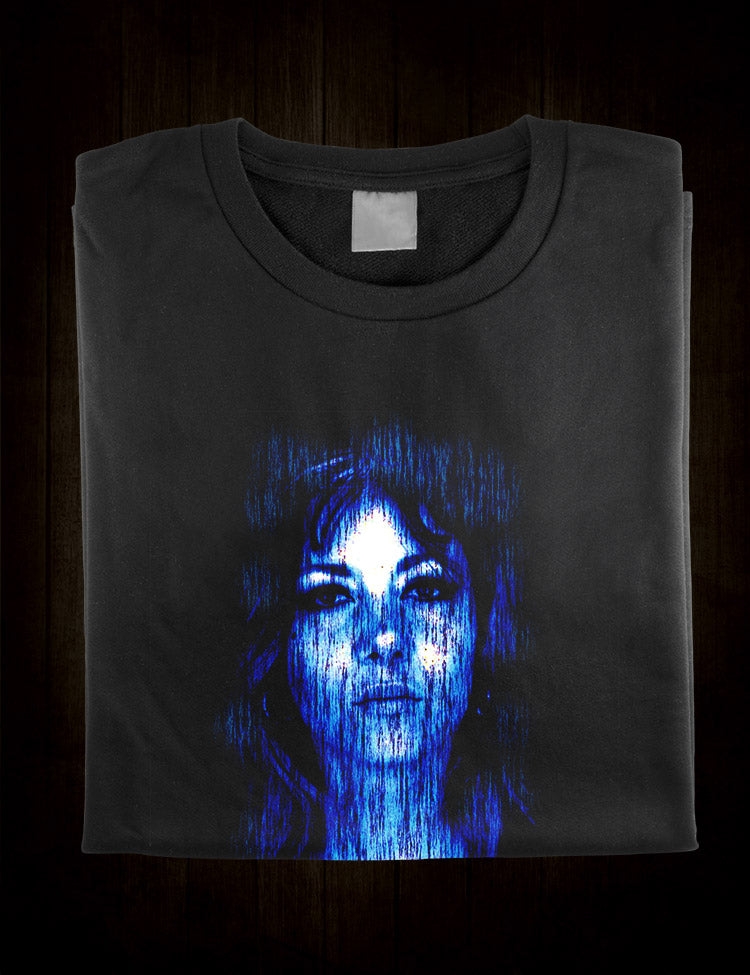
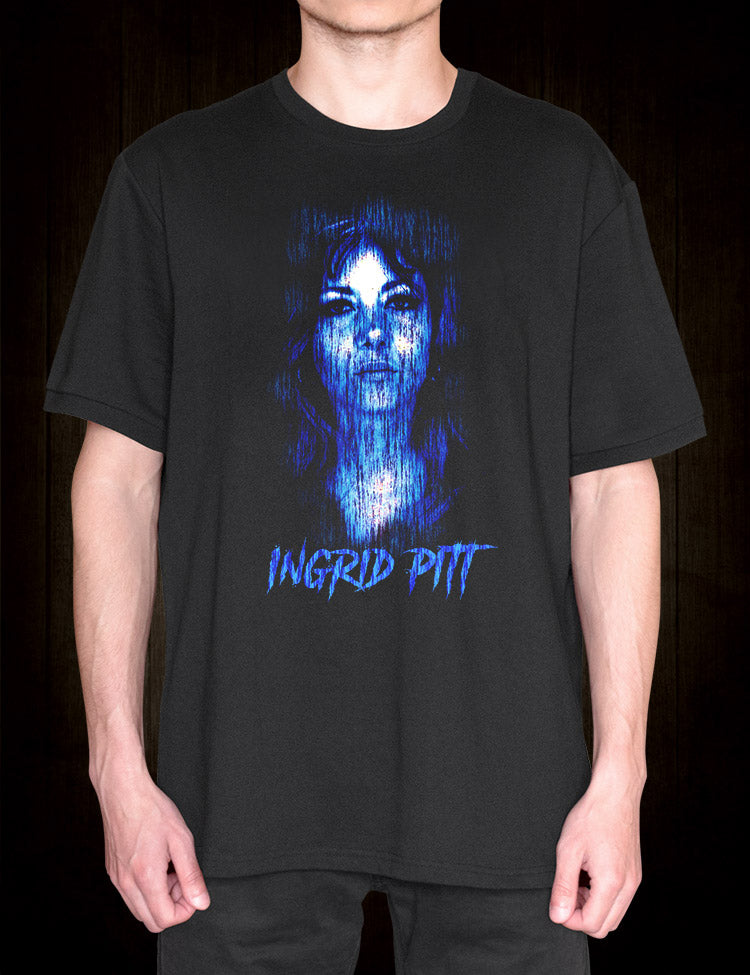
Ingrid Pitt T-Shirt

INGRID PITT T-SHIRT
Hammer Horror's Most Dangerous Leading Lady
Hammer's Gothic heroines were frequently expected to scream, flee and wait for Christopher Lee or Peter Cushing to arrive. Ingrid Pitt had other ideas. When she entered the studio's blood-red world at the beginning of the 1970s, she brought with her a combination of intelligence, sensuality and menace that turned the traditional horror heroine inside out. In The Vampire Lovers and Countess Dracula, Pitt was not waiting to be rescued. She was usually the person everyone else needed rescuing from.
Born Ingoushka Petrov in Warsaw in 1937, Pitt had already lived through experiences more extraordinary than anything Hammer could invent. As a child, she and her mother were imprisoned in the Stutthof concentration camp during the Second World War. They survived, and her subsequent journey took her through postwar Europe, theatre and eventually the international film industry. The distance between that childhood and the artificial horrors of a Hammer soundstage could scarcely have been greater.
After the war came Berlin, theatrical work associated with Bertolt Brecht's Berliner Ensemble and a move west. Pitt's early screen career included appearances in David Lean's Doctor Zhivago and Orson Welles's Chimes at Midnight, followed by a memorable supporting role opposite Richard Burton and Clint Eastwood in the 1968 wartime adventure Where Eagles Dare. Yet it was Hammer Films that discovered the screen identity with which she would become permanently associated.
Roy Ward Baker's The Vampire Lovers arrived in 1970, adapting Sheridan Le Fanu's 1872 novella Carmilla. Pitt played Carmilla, also known as Marcilla and Mircalla Karnstein, with considerably more personality than the decorative female vampires usually permitted by earlier Gothic cinema. The film became the first entry in Hammer's Karnstein Trilogy and pushed the studio further into the combination of sexuality, violence and period Gothic that characterised its early-1970s productions.
A year later came Countess Dracula, loosely inspired by the legends surrounding the Hungarian noblewoman Elizabeth Báthory. Pitt played the ageing Countess Elisabeth Nádasdy, who discovers that blood temporarily restores her youth. The premise gave Pitt one of Hammer's stranger leading roles: part Gothic monster, part tragic obsessive and part blackly comic aristocrat. Although her dialogue was ultimately dubbed, her physical performance remains one of the defining elements of Hammer's later period.
Her cult reputation extends well beyond those two films. Pitt appeared in the Amicus anthology The House That Dripped Blood, playing an actress whose involvement with vampire cinema becomes unexpectedly literal, and in 1973 joined Christopher Lee and Edward Woodward in Robin Hardy's The Wicker Man. Later work included Who Dares Wins, Smiley's People, Doctor Who and Steven Soderbergh's The Underneath.
Pitt also developed a substantial second career as a writer. Her autobiography, Life's a Scream, revisited her remarkable experiences, while other books explored murder, horror and the macabre. She became a familiar presence at horror conventions, where her willingness to engage with enthusiasts helped sustain the reputation of films that had once been dismissed by mainstream critics.
By the time of her death in 2010, Pitt had become something larger than the relatively small number of films on which her horror reputation was built. She represented a moment when British Gothic cinema became stranger, more adult and considerably less interested in helpless heroines. Half a century later, Carmilla Karnstein still looks completely at home in the dark.
💬 FREQUENTLY ASKED QUESTIONS (FAQs)
Q1: Was Ingrid Pitt in all three films of Hammer's Karnstein Trilogy?
A1: No. Pitt starred as Carmilla in The Vampire Lovers, the first film in the trilogy. The later films Lust for a Vampire and Twins of Evil continued the Karnstein theme without her.
Q2: Did Ingrid Pitt appear in Doctor Who more than once?
A2: Yes. Pitt played Queen Galleia in the 1972 Third Doctor serial The Time Monster and returned as Dr Solow in the 1984 Fifth Doctor story Warriors of the Deep.
Q3: What books did Ingrid Pitt write?
A3: Her published work included the autobiography Life's a Scream and books exploring horror, murder and macabre history, including The Ingrid Pitt Book of Murder, Torture and Depravity.