
Altamont 1969: How One Chaotic Concert Became the Mythical Death of the Sixties
The Sixties did not actually end on 6 December 1969.
Calendars are stubborn like that.
Yet popular culture has repeatedly returned to one Saturday at a remote California racetrack as the moment when flower power curdled, the counterculture lost its innocence and Woodstock's utopian promise received a brutal correction.
The Altamont Free Concert of 1969 certainly provided the necessary imagery: hundreds of thousands of people, motorcycles surrounding an absurdly low stage, Hells Angels, frightened musicians, fistfights and finally the killing of 18-year-old Meredith Hunter while the Rolling Stones performed.
But Altamont's reputation as “the end of the Sixties” tells us almost as much about how culture manufactures historical turning points as it does about the concert itself.
Woodstock's Improvised Evil Twin
The Rolling Stones wanted to finish their 1969 American tour with a free California concert. The idea was not especially radical. San Francisco's counterculture had a strong tradition of free outdoor performances, and the Stones themselves had already appeared at a successful Hyde Park concert in London.
The execution was another matter.
Possible venues came and went. Plans for Golden Gate Park collapsed. Sears Point Raceway fell through. Only on 4 December — two days before the show — did organisers settle on Altamont Speedway near Livermore.
There was now almost no time to prepare a site for the vast crowd already expected.
The stage was extremely low. Sanitation and medical facilities were inadequate. Traffic clogged the surrounding roads. Thousands abandoned vehicles and walked towards the speedway.
The mythology says Altamont was doomed.
The logistics suggest it simply had an impressive head start.

Motorcycles at the Stage
The most infamous decision involved the Hells Angels.
Accounts differ over precisely how their role was understood, but members of the motorcycle club were positioned around the stage and an arrangement involving $500 worth of beer became part of the day's increasingly combustible folklore.
Violence developed well before the Stones appeared.
Jefferson Airplane singer Marty Balin was knocked unconscious during an altercation. The Grateful Dead, who had helped shape the Californian free-concert culture that inspired the event, learned what was happening and left without playing.
By nightfall, the Stones finally took the stage in an atmosphere considerably removed from the promised celebration.
Hellwood's Altamont Speedway T-Shirt takes its imagery from that peculiar historical collision: rock spectacle, American counterculture and a racetrack that accidentally became shorthand for cultural collapse.
The Death That Became the Story
During the Rolling Stones' performance, Meredith Hunter approached the stage amid another disturbance.
Film footage showed Hunter holding a revolver. Hells Angel Alan Passaro attacked and fatally stabbed him. Passaro was subsequently tried for murder but acquitted after the jury accepted his claim of self-defence.
Three other people died accidentally during the event — two in a hit-and-run incident and another by drowning.
The killing of Hunter, however, became inseparable from Altamont because it happened directly in front of the stage and because cameras captured it.
The Maysles brothers and Charlotte Zwerin incorporated the footage into their 1970 documentary Gimme Shelter. Altamont was no longer merely remembered. It could be replayed.

Did Altamont Really End the Sixties?
The neat version of history places Woodstock on one side and Altamont on the other.
Woodstock becomes peace, community and possibility. Altamont becomes violence, paranoia and failure. Four months separate Eden from the fall.
Reality was never so obliging.
The late 1960s had already contained political assassinations, urban unrest, Vietnam, violent radicalism and the Manson murders. Woodstock itself involved immense logistical problems. The counterculture was never one unified movement whose innocence could be killed at a single concert.
Altamont nevertheless supplied a perfect ending because endings make history easier to remember.
A racetrack became a symbol. A badly organised concert became an epitaph.
That tension between messy history and cleaner mythology places Altamont naturally among Hellwood's Music of the Sixties designs and the darker American folklore of the Twisted Americana collection.
The Concert That Became a Metaphor
Altamont mattered. Meredith Hunter died. People were assaulted. The organisation was dangerously inadequate. None of that needs romanticising or exaggerating.
But its larger reputation was created afterwards.
Photographs, documentary footage, journalism and decades of retelling transformed one disastrous day into a historical full stop.
Perhaps that is why Altamont remains so compelling.
The Sixties did not die there.
They simply acquired an ending everyone could remember.
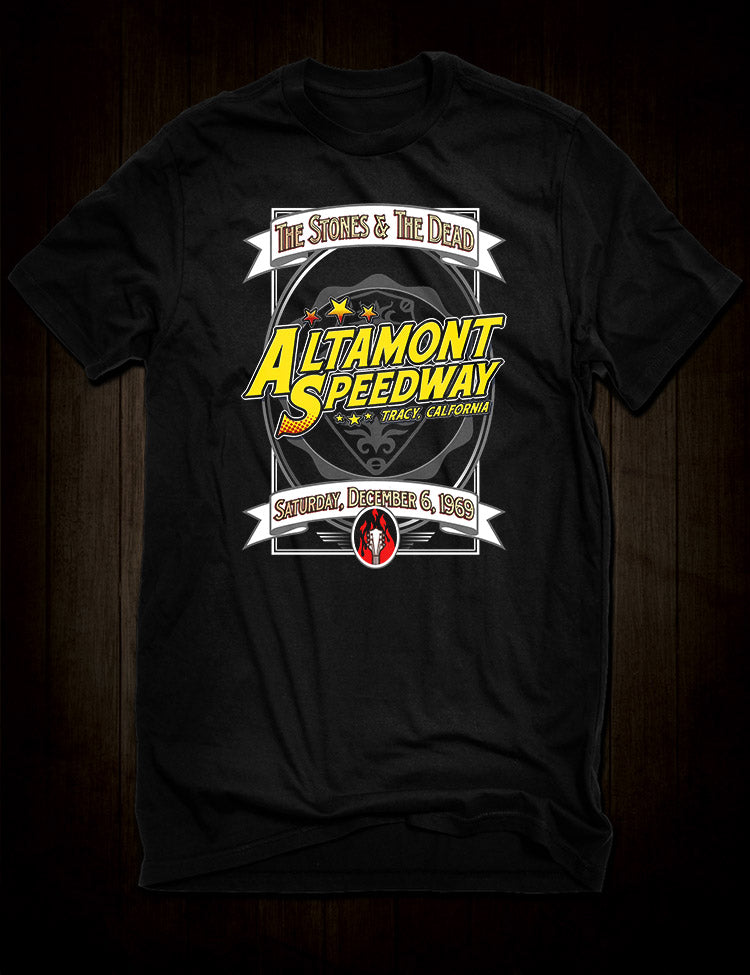
ALTAMONT SPEEDWAY T-SHIRT
A Hellwood tribute to 6 December 1969 — the chaotic California free concert that passed from rock history into the darker mythology of American counterculture.