


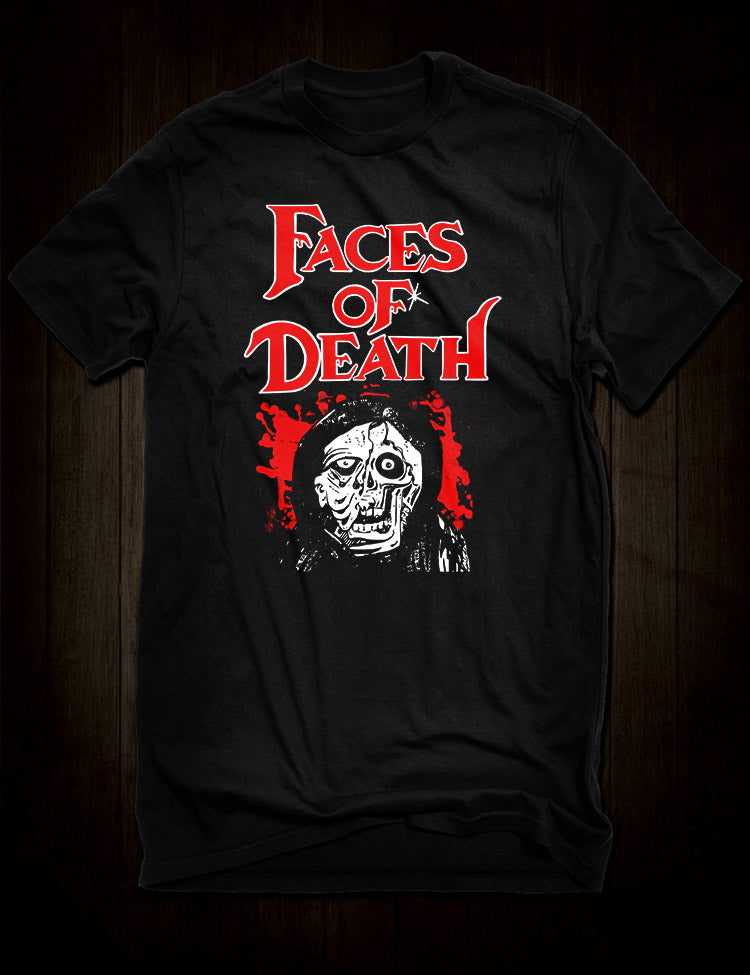
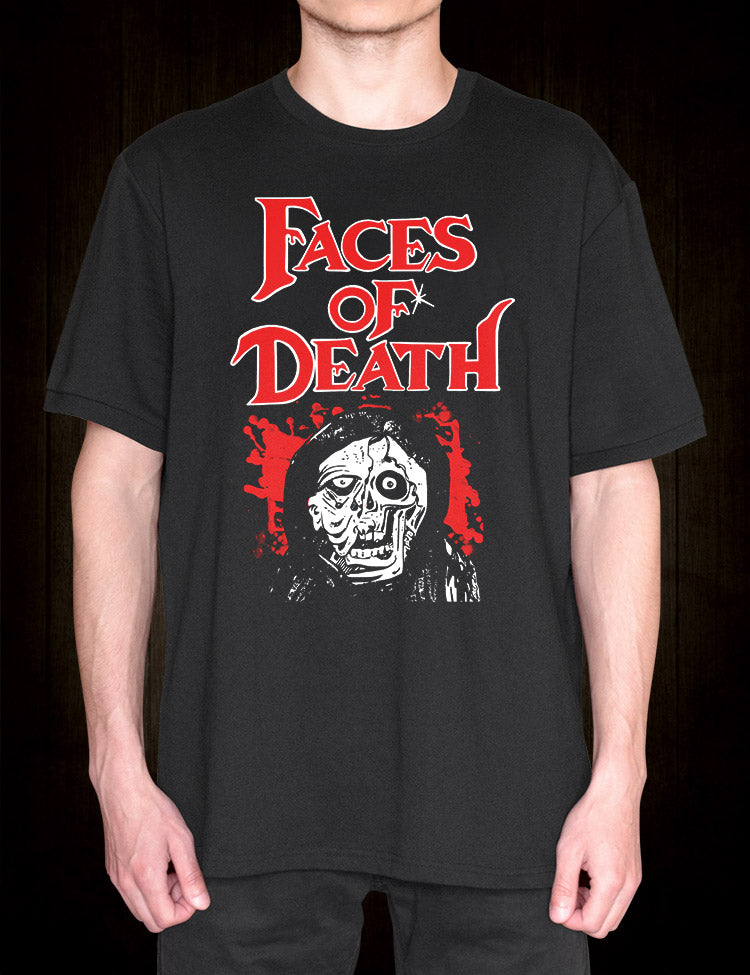

Faces Of Death T-Shirt

FACES OF DEATH T-SHIRT
The Forbidden Tape, the Schoolyard Rumours and the Birth of a Video-Era Legend
Long before streaming, smartphones and the endless circulation of disturbing footage online, a particular videotape acquired a reputation that seemed to travel faster than the film itself. It was spoken about in school corridors and whispered about in video shops. Some claimed it had been banned everywhere. Others insisted that no one who watched it would ever forget what they saw. Its title was Faces of Death.
First released in 1978, the American mondo-style shock film was made by John Alan Schwartz, who used the pseudonym Conan Le Cilaire. Presented through the fictional authority of pathologist Dr Francis B. Gröss, it assembled images of death, medical procedures, accidents and apparent acts of violence into a pseudo-documentary exploration of mortality.
The central deception was its claim to documentary authenticity. Real archival and documentary material appeared alongside elaborately staged sequences, with practical effects and editing designed to blur the boundaries between actuality and fabrication. Many of the most notorious episodes were reconstructions rather than genuine records of the events they purported to show.
This ambiguity proved vital to the film's notoriety. Viewers encountered a deliberately unstable mixture of genuine material and manufactured spectacle, often without being able to tell which was which. The uncertainty became as important as any single sequence. Was the audience witnessing documentary evidence, an exploitation-film trick, or some uncomfortable combination of the two?
Faces of Death followed the tradition of the mondo film, a genre associated with sensational documentary imagery and the exploitation of cultural taboos. Yet its arrival at the dawn of the home-video age allowed it to become something more elusive: a forbidden object whose reputation was sustained by rumour, copied tapes and the thrill of watching something supposedly beyond the limits of ordinary cinema.
Its imagery and marketing encouraged claims of prohibition and censorship, often circulated without reliable context. The film's notoriety outgrew its actual contents, turning it into a kind of analogue urban legend. For many people the idea of Faces of Death was far more influential than the experience of sitting through the film.
There is an uncomfortable history beneath that mythology. The production's mixture of staged violence and genuine disturbing documentary images raises questions about spectatorship and exploitation. The film asks its audience to observe death, but its commercial appeal depends on the very shock and curiosity it claims to examine.
Today, its visual techniques and claims to authenticity belong unmistakably to another media era. Yet the basic tension remains familiar: how much can an image be trusted, and what happens when disturbing material is presented as entertainment? In that respect, this notorious piece of cult cinema anticipated debates that would become far more widespread with online video.
The Faces of Death T-Shirt recalls the infamous original film, the underground culture of VHS horror and a time when a videotape could become legendary before anyone had even seen it.
A battered cassette. A terrible reputation. The question of what was really on the tape.
Some legends were made in the video shop.
FREQUENTLY ASKED QUESTIONS (FAQs)
Was everything in the original Faces of Death real?
No. The 1978 film combined genuine documentary and archival imagery with specially staged sequences and practical effects. Its ambiguous presentation helped create its controversial reputation.
What is a mondo film?
Mondo cinema is a tradition of sensational documentary-style filmmaking that presents unusual, shocking or taboo subjects, often using provocative editing and presentation to challenge or exploit audience curiosity.
Why did Faces of Death become such a notorious VHS title?
Its claims of authenticity, graphic reputation and circulation through home-video culture encouraged rumours that extended well beyond what many viewers had actually seen. It became a symbol of forbidden or transgressive viewing.