


The Wrong Man True Story: Hitchcock's Real-Life Nightmare in Queens
The most frightening Alfred Hitchcock film has no shower murder, crop-duster or murderous birds. It begins with a man trying to pay a dental bill.
On 14 January 1953, Christopher Emanuel "Manny" Balestrero, a double-bass player at New York's fashionable Stork Club, was arrested outside his home in Jackson Heights, Queens.
He had not robbed anyone.
Unfortunately, several people believed he had.
Three years later, Hitchcock turned the ordeal into The Wrong Man (1956), starring Henry Fonda and Vera Miles.
The remarkable part is not how much Hollywood invented. It is how much it barely needed to change.
A Loan, a Lookalike and a Police Car
Balestrero worked nights, supported a wife and two sons, and had the sort of finances that make a toothache an economic emergency.
When his wife Rose needed dental treatment, he visited a Prudential insurance office to ask about borrowing against her policy.
Employees thought they recognised the man who had robbed the office.
Police were contacted, and Balestrero was taken in for questioning. Three witnesses identified him.
His innocence offered little protection against the accumulating confidence of everyone else.
In the film, detectives take Manny to businesses connected with other robberies and ask him to reproduce the wording of a hold-up note.
He writes "draw" instead of "drawer"—the same mistake attributed to the criminal.
A spelling error becomes an accusation.
Hitchcock's familiar innocent-man plot had suddenly acquired an unpleasant advantage: it had happened to an actual innocent man.


The Horror of Ordinary Procedure
Most Hitchcock heroes escape across rooftops, trains or national monuments.
Manny sits in police cars, waits in corridors, is fingerprinted, and watches a cell door close.
Hitchcock shot extensively in New York, using real locations connected to the case: the Stork Club, streets in Queens, police stations and courtrooms.
Some people associated with the original events even appeared as themselves.
The result looks closer to a police documentary than a glamorous thriller.
Robert Burks's black-and-white photography and Bernard Herrmann's restrained score make the ordinary details unbearable.
The police need not behave like pantomime villains. They only have to proceed with the assurance that the correct suspect is already sitting in front of them.
Fonda's subdued performance is essential.
He does not deliver speeches about justice. He tries to be helpful, answer questions and get home.
Each cooperative gesture seems to make matters worse.
The falsely accused man was a familiar Hitchcock obsession, appearing in films such as The 39 Steps and Strangers on a Train.
But in The Wrong Man, there is no thrilling escape across the countryside.
There is only the system, and the terrible possibility that it has already decided who you are.


What Happened to the Real Manny Balestrero?
The real Balestrero was charged with two armed robberies.
His lawyer, Frank O'Connor, prepared a defence, but an outburst by a juror led to a mistrial in April 1953.
Before a second trial, police caught the actual robber, Charles James Daniell, who admitted the offences.
The charges against Balestrero were dismissed.
That should be the point where the lights come up and everybody goes home.
Unfortunately, the ordeal had spread beyond the courtroom.
Rose suffered a serious mental-health crisis and was admitted to a sanitarium.
The family had endured financial strain, public suspicion and the knowledge that ordinary life could be dismantled by a mistaken identification.
Hitchcock did not invent this damage.
Vera Miles's performance gives the film its most devastating turn: the accused man may be released, but the family cannot simply return to the afternoon before his arrest.
The Ending That Was Too Neat
The film's closing text says Rose left hospital after two years, completely recovered, and that the family lived happily in Florida.
It is an unusually reassuring ending for a story that has spent nearly two hours demonstrating how little reassurance the world offers.
There is a serious qualification.
According to later testimony from the Balestrero family reported by the American Film Institute, Rose never fully recovered; she died in 1982.
Manny lived until 1998.
Hitchcock had announced the film in silhouette, telling audiences they were about to see a true story.
He avoided his customary playful cameo, preferring to introduce a nightmare that needed no fictional murderer.
The film drew on Herbert Brean's 1953 Life magazine account and Maxwell Anderson's treatment of the case.
Its documentary methods would later influence Martin Scorsese, who singled out its camera movement and atmosphere of guilt and paranoia when discussing Taxi Driver.
What makes The Wrong Man so difficult to shake is not the arrest itself.
It is the possibility that being cleared and being restored are entirely different things.
In Hitchcock's other thrillers, the wrong man often gets to run.
Manny Balestrero had to stand still and wait for somebody to believe him.
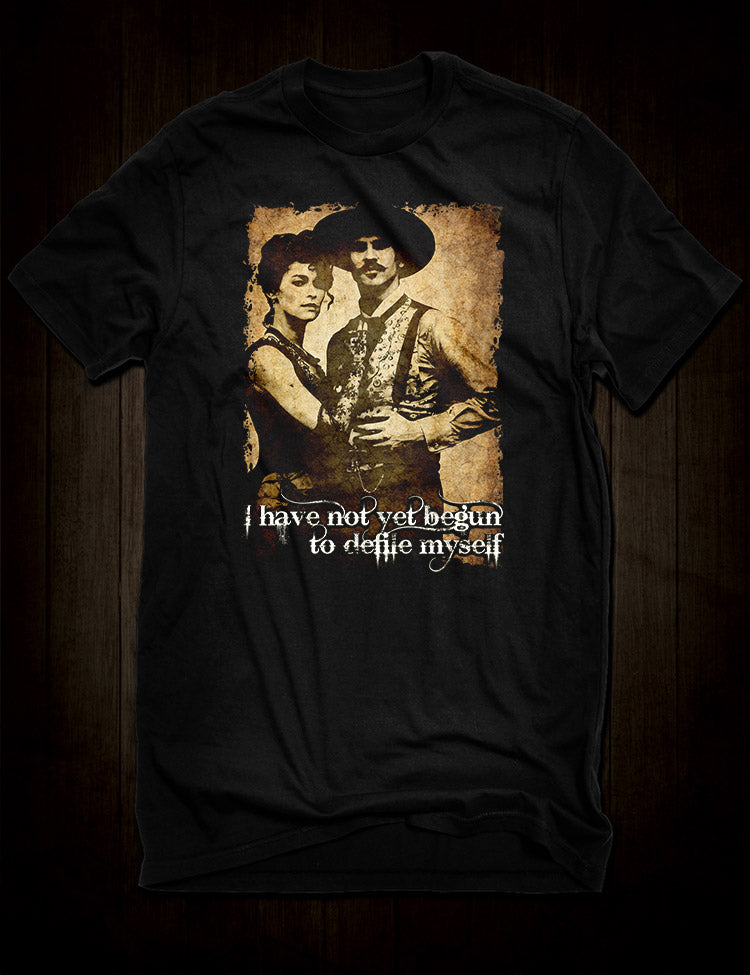
Explore Hellwood's The Wrong Man T-Shirt, inspired by Hitchcock's extraordinary true-crime thriller.
For more suspense and classic cinema, discover the Alfred Hitchcock Inspired T-Shirt Collection and the Crime & Thriller Movie T-Shirts Collection.
Another of Hitchcock's unsettling explorations of guilt and identity is celebrated in Hellwood's Strangers on a Train T-Shirt.

THE WRONG MAN T-SHIRT
An innocent man has nothing to fear. Apparently.
A Hellwood tribute to Alfred Hitchcock's haunting 1956 thriller starring Henry Fonda and Vera Miles.
Featuring a vintage-inspired film-poster design celebrating the extraordinary true story of Christopher Emanuel Balestrero and one of Hitchcock's most unsettling films.
VIEW THE WRONG MAN T-SHIRT