




Nick Cave's Papa Won't Leave You, Henry: The Lullaby That Became a Nightmare
There are lullabies designed to send children peacefully to sleep. Then there is Nick Cave's Papa Won't Leave You, Henry, which sounds like something a man might sing while running from the end of the world.
Released in 1992 as the opening track of Henry's Dream, the song is a relentless journey through violence, sexual degradation, religious imagery and urban despair.
Yet its central refrain offers a promise of protection.
That contradiction is what makes it so extraordinary.
Over more than five minutes, Cave transforms the familiar language of reassurance into something increasingly desperate.
The result is part murder ballad, part nightmare, and part grotesque hymn to endurance.
A Lullaby from the Wrong Side of Town
The song begins with a solitary narrator walking through a hostile landscape.
He encounters religious figures, remembers violent deaths, revisits failed relationships and wanders through increasingly disturbing environments.
Rain falls almost continuously.
The world seems to be decomposing around him.
Between these episodes comes the repeated assurance that Papa will not abandon Henry.
The words suggest parental protection, but the surrounding narrative offers little evidence that anybody is safe.
That tension gives the song its peculiar emotional force.
It resembles a traditional folk narrative in which a traveller moves from one terrible encounter to another, accumulating suffering without ever reaching a recognisable destination.
The repeated chorus becomes a kind of ritual.
Whether it represents genuine comfort, desperate self-persuasion or bitter irony is left unresolved.
Cave has frequently drawn on religious language and traditional storytelling, but here those influences are pushed towards something almost feverish.
The narrator keeps walking because stopping appears even less attractive.


What Does Papa Won't Leave You, Henry Mean?
The most interesting question is not what happens in the song, but why its repeated promise becomes more unsettling with every verse.
At first, the refrain sounds like an uncomplicated declaration of loyalty.
Someone is telling Henry that he will not be abandoned.
But the narrator's experiences offer no corresponding sense of security.
Violence appears arbitrary. Relationships collapse. Religious certainty offers little consolation.
The song's imagery repeatedly contrasts the possibility of salvation with a world apparently indifferent to suffering.
That is familiar territory for Cave, whose writing often places biblical language beside characters who seem spectacularly unlikely to benefit from divine intervention.
The identity of Henry is less important to the song's effect than the promise addressed to him.
Henry becomes someone who needs reassurance precisely because the surrounding world provides none.
One interpretation is that the refrain represents the stubborn human need to believe that somebody, somewhere, will remain faithful.
Another is that the promise is hopelessly inadequate.
The song allows both readings to coexist.
It is difficult to imagine a more characteristically Cave arrangement: a gesture of tenderness surrounded by enough catastrophe to make the tenderness seem almost absurd.
Henry's Dream and the Art of the Murder Ballad
Henry's Dream arrived in 1992, when Nick Cave and the Bad Seeds were developing an increasingly distinctive mixture of gothic storytelling, blues, rock and religious imagery.
The album contains nine songs, including Jack the Ripper, John Finn's Wife, Straight to You and Christina the Astonishing.
Several unfold like miniature narratives, populated by desperate men, doomed lovers and characters who might have wandered out of an especially unforgiving nineteenth-century ballad.
Papa Won't Leave You, Henry establishes that atmosphere immediately.
Its narrative accumulates increasingly grotesque episodes while the music drives forward with the determination of a runaway train.
The traditional murder ballad often tells a relatively straightforward story: a crime, a victim, a consequence.
Cave takes the form apart.
Here, violence becomes part of the landscape rather than the climax of a single narrative.
There is no reassuring moral order waiting at the end.
The song is less concerned with solving a crime than describing a world in which brutality has become ordinary.
The Album That Nick Cave Wanted to Sound Different
The recording of Henry's Dream was itself a troubled undertaking.
Producer David Briggs, known for his work with Neil Young, favoured a live-in-the-studio approach intended to capture the band's performances with immediacy.
Cave was dissatisfied with the results.
He and Mick Harvey subsequently became involved in remixing the recordings.
The disagreement was not simply a matter of technical polish.
These songs depended on atmosphere, momentum and a particular kind of controlled disorder.
The tension between studio discipline and the band's unruly energy became part of the album's history.
The following year's Live Seeds presented concert performances of material from this period, allowing listeners to hear the songs in a more volatile setting.
For Papa Won't Leave You, Henry, that volatility feels entirely appropriate.
The song's narrator is already struggling to remain upright in a world that refuses to behave.
A perfectly tidy performance would seem almost impolite.


The Promise That Survives the Nightmare
More than three decades after its release, Papa Won't Leave You, Henry remains one of Cave's most striking examples of narrative songwriting.
Its violence is extreme, its imagery deliberately excessive, and its emotional centre surprisingly fragile.
What stays with the listener is not any single grotesque episode.
It is the repeated attempt to offer comfort in circumstances where comfort seems impossible.
That may be the song's strangest achievement.
For all its cruelty and theatrical darkness, it remains stubbornly attached to the idea that somebody might still be worth protecting.
The road is terrible. The promise continues.
Explore Hellwood's Punk & Alternative Music T-Shirts, Music T-Shirts Collection and Famous Song Lyrics Collection for more music from the darker edges of popular culture.

NICK CAVE T-SHIRT
A promise from the darker side of rock and roll.
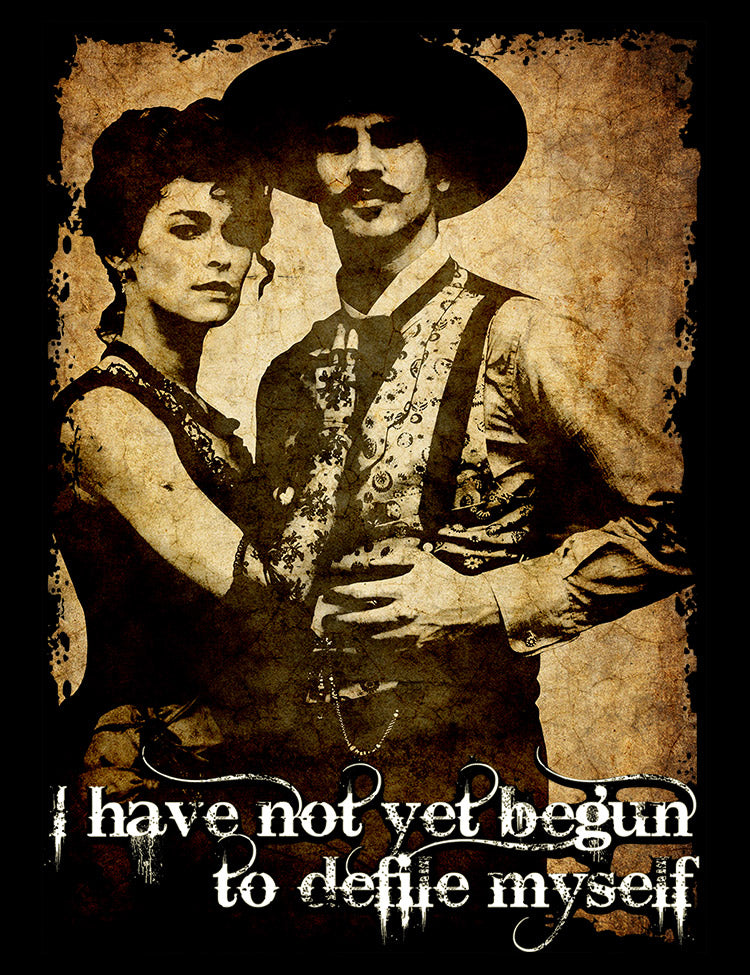
A Hellwood tribute to Nick Cave and the Bad Seeds, featuring lyrics from the extraordinary 1992 song Papa Won't Leave You, Henry.
Inspired by the gothic storytelling, violent imagery and uncompromising musical world of Henry's Dream.
VIEW THE NICK CAVE T-SHIRT