






Was the House of the Rising Sun Real? The Song's Forgotten Past
Somewhere in New Orleans, according to one of rock music's most enduring songs, stands a house that has ruined more lives than a particularly determined landlord. The Animals made it famous in 1964, but they did not invent the building, the warning or the tune.
What does House of the Rising Sun mean? Nobody can even identify the house with certainty. Was it a brothel, a gambling den, a prison, or simply the perfect address for a cautionary tale?
The song has outlived every convincing answer.
A Real Address, or a Convenient Legend?
New Orleans has supplied several candidates for the Rising Sun, including buildings associated with nineteenth-century lodging and prostitution. The city's reputation for vice makes the explanation appealing. Unfortunately, an appealing story and a documented connection are not the same thing.
The earliest surviving versions describe a place where the narrator's life has gone badly wrong, but they do not provide a street number, an owner or a date.
Some versions speak in a woman's voice, others in a man's. The trouble might be sexual exploitation, drink, gambling or an entire collection of poor decisions.
Journalist Ted Anthony spent years investigating the song for his book Chasing the Rising Sun. Even the question of whether a particular New Orleans establishment inspired it remained unresolved.
The name could have travelled with the song rather than the other way round.
That is the irritating beauty of folklore. It rarely comes with a deed registry.


The Song Was Old Before Rock and Roll
The familiar story begins long before electric guitars.
In 1925, folklorist Robert Winslow Gordon printed lyrics in Adventure magazine. By 1933, Tennessee musician Clarence "Tom" Ashley and harmonica player Gwen Foster had recorded "Rising Sun Blues".
Ashley was drawing on an older oral tradition, not unveiling a new composition. Songs moved between performers, families and communities, shedding verses and acquiring new ones as they went.
The singer might change; the warning survived.
Some researchers hear echoes of much older British ballad traditions, but there is no agreed birthplace or original songwriter.
The safest answer to "Who wrote House of the Rising Sun?" is also the least satisfying: nobody knows.
Its history is a journey through the kind of country and folk music that existed before anybody thought to draw a neat border around genres.
A Sixteen-Year-Old Voice in Kentucky
One of the song's most important recordings was made nowhere near Louisiana.
In September 1937, song collector Alan Lomax recorded sixteen-year-old Georgia Turner in Middlesboro, Kentucky.
She was the daughter of a coal miner, and her unaccompanied performance of "The Rising Sun Blues" preserved a version that would help carry the song into the twentieth-century folk revival.
The Library of Congress still holds the archival catalog record, identifying Turner as the singer and Lomax and Elizabeth Lyttleton as recordists.
It is a small, matter-of-fact piece of documentation for a song that eventually became enormous.


John and Alan Lomax included the song in their 1941 collection Our Singing Country, drawing on Turner's performance and additional verses collected from Bert Martin.
Woody Guthrie, Josh White, Lead Belly and other performers subsequently carried versions into wider circulation.
Turner did not become a household name.
The tune did.
How Newcastle Gave It an Electric Afterlife
In the early 1960s, the song passed through the Greenwich Village folk scene. Dave Van Ronk developed a distinctive arrangement; Bob Dylan recorded his own version for his 1962 debut album.
Then a band from Newcastle got hold of it.
The Animals' 1964 recording turned a wandering folk lament into an electric, organ-driven drama. Eric Burdon's voice sounded less like a singer recalling a cautionary tale than a man giving evidence from the scene of the crime.
It topped the charts in Britain and America. Suddenly, an old song with no certain author had become one of the defining recordings of the British Invasion.
House of the Rising Sun has since been interpreted by countless artists, often with radically different arrangements.
Its durability comes partly from that flexibility: the setting is specific enough to feel real, yet the disaster is vague enough for anyone to recognise.
There may never have been one notorious house. There certainly was a sixteen-year-old singer in Kentucky, a travelling melody and a succession of musicians who understood that the best warnings are often the ones nobody heeds.
Hellwood's House of the Rising Sun T-Shirt takes its cue from the song's darker atmosphere.
For more musical histories worth following, explore the Country & Folk Music collection, the Classic Rock collection and Hellwood's Song Lyric T-Shirts collection.
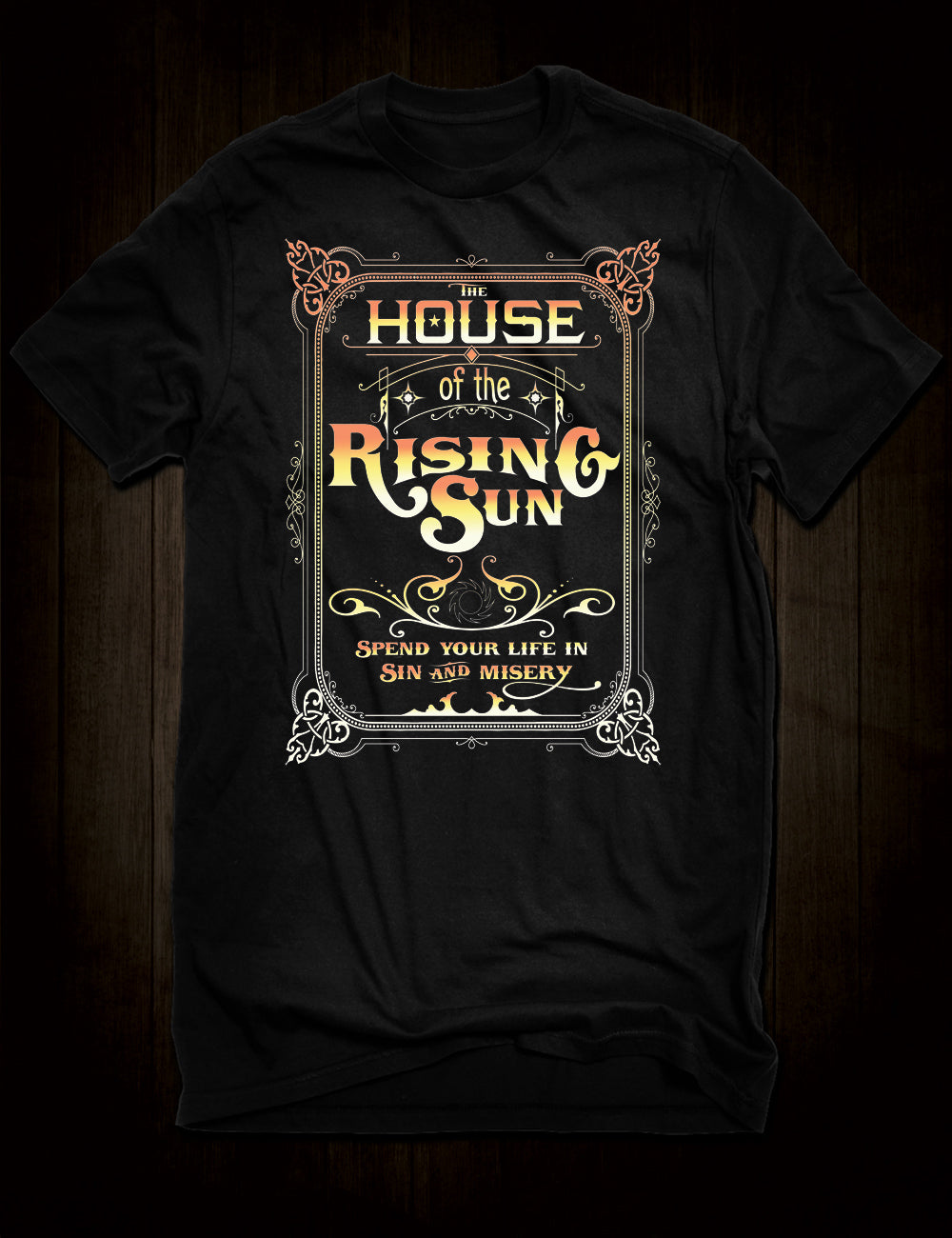
THE HOUSE OF THE RISING SUN T-SHIRT
Sin, misery and one of music's most mysterious addresses.
A Hellwood tribute to the traditional folk song made famous by The Animals in 1964, celebrating its enduring atmosphere of regret, temptation and Southern Gothic mythology.
Featuring elaborate vintage-inspired typography in warm orange, yellow and ivory against a black background, the design captures the song's darkly romantic character.
VIEW THE HOUSE OF THE RISING SUN T-SHIRT