


Exploding Plastic Inevitable: The 1966 Show That Invented the Modern Multimedia Gig
Imagine paying for a rock concert and discovering that somebody has also brought several film projectors, coloured slides, dancers, strobe lights, mirror balls and enough sensory interference to make finding the actual stage unexpectedly difficult.
In 1966, Andy Warhol called the result the Exploding Plastic Inevitable.
Part concert, part film screening, part nightclub and part deliberate nervous-system malfunction, the EPI placed the Velvet Underground and Nico inside an environment of overlapping moving images, lights and performance. The audience did not simply watch it.
They were stuck inside it.
Decades before arena bands routinely travelled with walls of video screens and clubs treated projected imagery as part of the music, Warhol's downtown experiment was already dismantling the border between sound and image.
From the Factory to the Dom
Warhol's relationship with the Velvet Underground began in late 1965. By January 1966, the band was appearing in an experimental performance called Andy Warhol, Up-Tight, including a famously provocative appearance at a New York Society for Clinical Psychiatry dinner.
The idea expanded.
In April, the newly named Exploding Plastic Inevitable settled into the Dom, a Polish meeting hall at 23 St Mark's Place in Manhattan. The Warhol Museum describes performances involving three to five films projected simultaneously, multiple slide projectors, strobe lights, moving spots and mirror balls.
Onstage were the Velvet Underground and Nico. Around them danced Factory figures including Gerard Malanga and Mary Woronov. Across them ran Warhol's films and Screen Tests.
Hellwood's Andy Warhol's Exploding Plastic Inevitable T-Shirt returns to that moment when a rock show stopped behaving like a rock show.
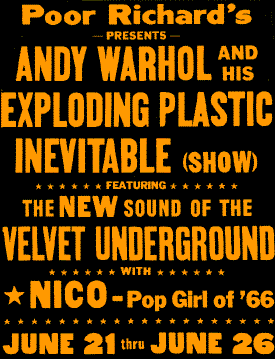
The Velvet Underground Provided the Noise
The choice of house band was not exactly soothing.
Lou Reed, John Cale, Sterling Morrison and Maureen Tucker were developing music built from repetition, drone, distortion and subjects that respectable mid-1960s pop generally preferred to leave outside.
Warhol's intervention gave them something valuable: an environment where being abrasive was not a commercial defect.
The Warhol Museum records that the relationship developed into the band's incorporation into both Up-Tight and the EPI. Warhol also secured studio time for their first album sessions at New York's Scepter Studios in April 1966, allowing the unsigned group to record without conventional record-company supervision.
Inside the EPI, their music became only one layer. Film projections landed on musicians, dancers, walls and spectators. Slides were moved manually. Strobes interrupted vision. A mirror ball scattered fragments of light across a room already overloaded with images.
Browse Hellwood's Music of the Sixties collection for more artefacts from a decade when popular culture became increasingly suspicious of sitting still.
The Audience Became Part of the Screen
This was the important shift.
Traditional cinema keeps the audience in darkness and the image safely contained inside a rectangle. A conventional concert separates performers onstage from spectators below.
The EPI muddied both arrangements.
Projections escaped the screen and landed on bodies. Dancers moved through the imagery. Spectators crossed beams of light and became temporary components of the show themselves.
A contemporary 1966 review quoted by the Warhol Museum described the experience as something constantly slipping between meaningful synchronisation and random confusion. That instability was the point. There was no single correct place to look.
Warhol was no longer simply making an image.
He was constructing an environment.

Before the Big Screens Came the Projectors
The Exploding Plastic Inevitable lasted only through 1966 and 1967, but its basic grammar escaped quickly.
Rock concerts increasingly treated lighting and projected imagery as creative elements rather than decoration. Psychedelic light shows developed their own visual language. Clubs, raves, performance artists and eventually stadium tours embraced the idea that music could occupy an entire visual environment.
The equipment changed. The principle did not.
The Warhol Museum still treats the EPI as central enough to Warhol's work to maintain an immersive gallery interpretation built from multiple projectors, films, patterned slides and recorded Velvet Underground drones.
For more music that grew from the margins rather than the middle, Hellwood's Punk & Alternative Music collection follows the noise forward, while the wider Music T-Shirts collection takes the less hazardous route through popular music history.
The Show That Refused to Stay on Stage
The EPI matters because it treated media as something that could collide.
Film did not need a cinema. Art did not need a gallery wall. Rock music did not need to be presented as four people standing beneath stage lights while everybody else politely faced forward.
Put everything together, turn it up too loud and allow the components to interfere with one another.
In 1966, that was an underground provocation.
Today, a concert without screens, projections or synchronised visuals can feel positively austere.
The plastic proved considerably more inevitable than anyone expected.

ANDY WARHOL'S EXPLODING PLASTIC INEVITABLE T-SHIRT
A Hellwood tribute to the strobe-lit collision of the Velvet Underground, experimental film and downtown New York performance culture that helped turn the rock concert into something considerably stranger.