






Charles Peace: The Victorian Murderer Who Became a Criminal Celebrity
Long before newspapers discovered celebrity gangsters and television discovered true crime, Victorian Britain had Charles Peace.
Born in Sheffield in 1832, Peace was a burglar, armed criminal and murderer whose talent for disguises and repeated escapes made him one of the most notorious men of the 1870s. Yet the figure who survived in popular culture was stranger still: part murderer, part master criminal and eventually something uncomfortably close to a folk hero.
The history behind Hellwood’s Charles Peace T-Shirt therefore offers an early lesson in what happens when violent crime meets mass entertainment.
A Burglar With a Talent for Reinvention
Peace grew up in industrial Sheffield and suffered a serious leg injury while young. His adult life developed into a long cycle of burglary, imprisonment, release and further crime.
What distinguished him from innumerable Victorian thieves was his ability to disappear.
Peace changed names, addresses and appearance. He could manipulate his facial expression, alter his clothing and adopt convincing disguises. After fleeing Yorkshire, he lived in London under the name John Ward, maintaining an outwardly respectable existence while carrying out burglaries.
The contrast was irresistible to newspapers. Here was a dangerous criminal apparently capable of walking through ordinary Victorian society while police searched for somebody else entirely.
Two Murders and One Wrongly Convicted Man
The clever-burglar mythology can obscure why Peace was being hunted.
In 1876 Police Constable Nicholas Cock was shot dead while interrupting a burglary in Manchester. Another man, William Habron, was convicted of the murder. Peace later confessed that he had killed Cock, eventually clearing Habron.
On 29 November 1876, Peace shot and killed civil engineer Arthur Dyson in Sheffield. Peace had developed an obsessive relationship with Dyson’s wife Katherine, although precisely what existed between them became bitterly disputed at his eventual trial.
He escaped and remained at large until 1878, when policeman Edward Robinson caught him during a burglary at Blackheath in London despite Peace shooting Robinson in the arm.
Peace was ultimately convicted of Dyson’s murder and hanged at Armley Prison in Leeds on 25 February 1879. :contentReference[oaicite:3]{index=3}

The Murderer Becomes a Penny-Dreadful Hero
Execution might reasonably be expected to conclude a criminal career. In Peace’s case it launched the franchise.
His ability to evade police had already made him a press sensation. Almost immediately after his death, publishers began transforming those exploits into popular entertainment.
Dartmouth College’s collection of Victorian popular fiction includes Charles Peace, or, The Adventures of a Notorious Burglar, published in London in 1879. The sprawling penny dreadful converted a contemporary murderer into the sort of ingenious criminal adventurer normally found in fiction.
This was part of a flourishing market for inexpensive serial stories sold to mass audiences. Highwaymen, burglars, monsters and murderers became recurring heroes and villains, their adventures growing more elaborate with every penny instalment.

From Chamber of Horrors to Popular Culture
Peace did not remain confined to cheap print. Madame Tussaud’s displayed his likeness among the notorious criminals of its Chamber of Horrors, where visitors could encounter murder as entertainment without the inconvenience of attending an actual execution.
His name continued appearing in books, plays and films. Arthur Conan Doyle mentioned Peace in the Sherlock Holmes story The Adventure of the Illustrious Client, while the 1949 British film The Case of Charles Peace reconstructed his career with Michael Martin-Harvey in the title role. Even later British comics converted him into the roguish star of The Astounding Adventures of Charlie Peace.
Each retelling pushed the legend a little further from the historical man. Murder became melodrama. Evasion became ingenuity. A violent burglar gradually acquired the glamour of the master criminal.
That transformation is what makes Charles Peace interesting now. Modern true crime did not invent the uncomfortable business of turning criminals into entertainment. Victorian publishers, newspapers and wax museums had already discovered the formula.
Explore more appropriately disreputable history in Hellwood’s British History T-Shirts, True Crime T-Shirts and wider Historical T-Shirts.
Charles Peace was executed in 1879. Charlie Peace, master burglar, criminal chameleon and Victorian antihero, proved considerably harder to kill.
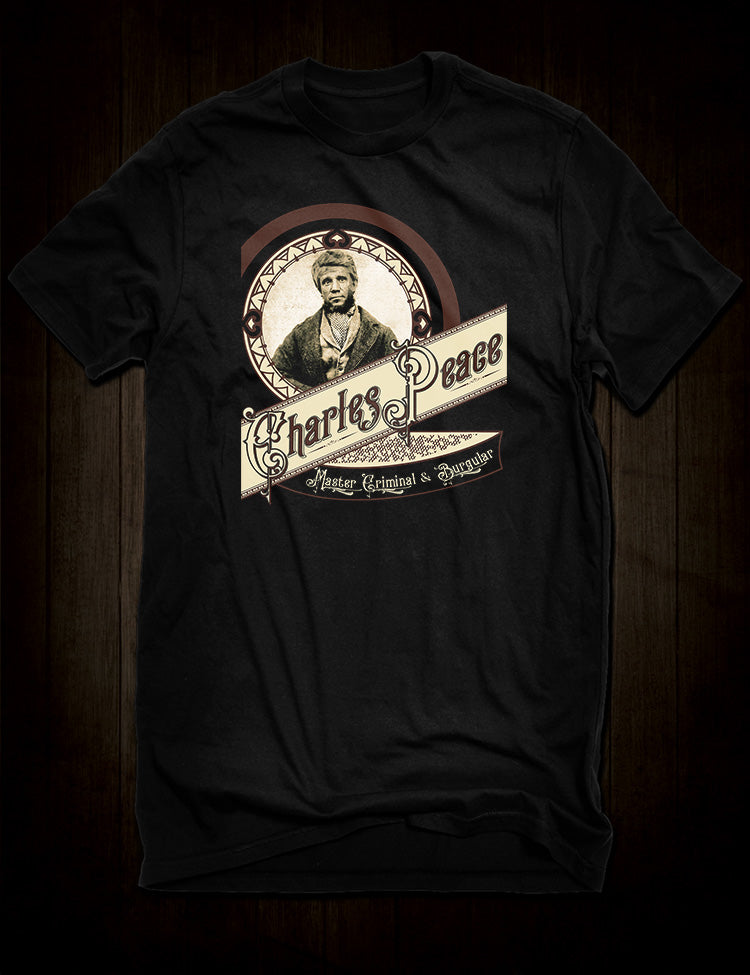
CHARLES PEACE T-SHIRT
A Hellwood tribute to Sheffield’s notorious Victorian burglar, murderer, master of disguise and one of Britain’s earliest true-crime celebrities.