






Dark Was the Night: How Blind Willie Johnson’s Gospel Blues Left Texas for Interstellar Space
Somewhere beyond the planets, a blind Texas street preacher is still singing.
Not literally, admittedly. What is travelling through interstellar space is a gold-plated copper record attached to each of NASA's two Voyager spacecraft. Among its Bach, Beethoven, Chuck Berry, Javanese gamelan and sounds of life on Earth is one of the strangest and most affecting recordings American music ever produced.
Blind Willie Johnson's “Dark Was the Night, Cold Was the Ground” contains no conventional lyrics. There is slide guitar, humming, moaning and roughly three minutes of almost unbearable human feeling.
Recorded in Texas in 1927, it took fifty years to reach the launch pad.
A Preacher With a Guitar
Much of Blind Willie Johnson's early biography remains frustratingly uncertain. The Library of Congress gives his life as 1897–1945 and describes him as an African-American guitar evangelist from Texas.
What is considerably better documented is the music.
Johnson was a religious performer rather than a secular bluesman. His repertoire came from gospel songs, spirituals, Biblical stories and hymns, delivered with an extraordinarily rough vocal attack and highly expressive slide guitar.
On 3 December 1927, he entered a temporary Columbia recording studio in Dallas and recorded six selections. They included “It's Nobody's Fault but Mine”, “Jesus Make Up My Dying Bed” and the performance that would eventually leave the Solar System.
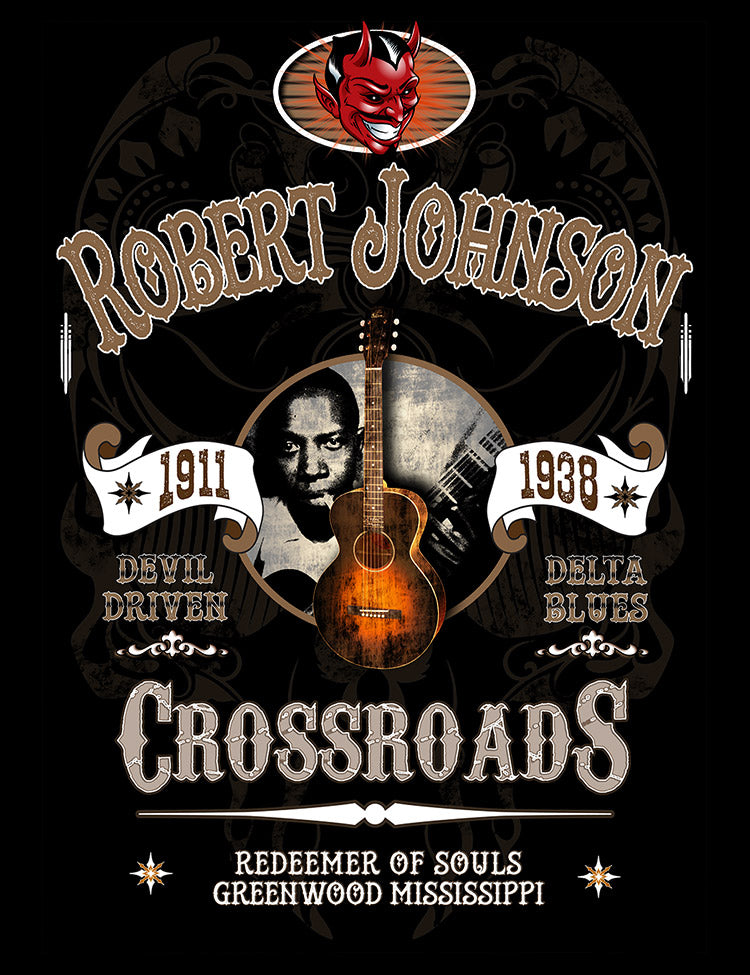
Hellwood's Blind' Willie Johnson T-Shirt takes its line directly from that remarkable recording.

The Song Without Words
“Dark Was the Night” grew from an eighteenth-century English hymn usually known as “Gethsemane”. Its subject was Christ's anguish on the night before the Crucifixion.
Johnson removed the words.
Instead, his guitar carries the structure while his voice hums and moans above it. The Library of Congress notes that the technique echoes the wordless responses of a church congregation. Guitar and voice answer one another until distinguishing accompaniment from expression becomes almost pointless.
There is nothing technically cosmic about it. No grand orchestration. No attempt to sound futuristic.
That would become part of its peculiar suitability for space.
Johnson recorded only 30 issued titles between 1927 and 1930. For more music built from similarly raw American traditions, Hellwood's Blues T-Shirt Collection and Country & Folk Music T-Shirts head considerably further down the dirt road.
NASA Needs a Playlist
In 1977, Voyager 1 and Voyager 2 were prepared for journeys through the outer Solar System and eventually into interstellar space.
A committee led by Carl Sagan assembled a message to accompany them: a 12-inch gold-plated copper phonograph record containing greetings, natural sounds, photographs and music intended to represent something of life on Earth.
The musical selection had an impossible brief. How do you explain humanity when your hypothetical audience has never heard a human being?
The final record ranged across centuries and continents. Bach went aboard. Beethoven went aboard. So did Chuck Berry's “Johnny B. Goode”.
And so did Blind Willie Johnson.

Why Send This Song?
The choice becomes more interesting the longer you consider it.
“Dark Was the Night” requires no English. It does not even require an understanding of Christianity to communicate grief, loneliness and yearning. Whatever Johnson intended religiously, the emotional information survives without translation.
That made a recording made under the technological limitations of 1927 unexpectedly useful for the most ambitious message-in-a-bottle ever attempted.
The Library of Congress added it to the National Recording Registry in 2010, recognising a performance whose influence had already travelled through blues, gospel, rock and film music.
NASA had simply given it a larger distribution area.
The Longest Tour in Music History
Voyager 1 entered interstellar space in 2012. The spacecraft continues moving outward, carrying a recording made by a musician who spent much of his life singing religious songs on Texas streets.
There is something almost suspiciously poetic about that trajectory.
A man records a wordless lament in a temporary Dallas studio. Half a century later, scientists decide that it says something sufficiently important about being human to send it towards the stars.
Browse Hellwood's wider Music T-Shirt Collection for more musicians whose influence travelled rather farther than anyone originally expected.
Most records hope for immortality.
Blind Willie Johnson's has a head start.

BLIND' WILLIE JOHNSON T-SHIRT
A Hellwood tribute to the Texas gospel-blues musician whose haunting “Dark Was the Night, Cold Was the Ground” travelled from a 1927 recording session all the way to the Voyager Golden Record.