








The Evolution of British Crime Drama in the 1980's
Introduction: From Cosy Cases to Cold Reality
There was a time when British crime drama unfolded like a well-set dining table: orderly, familiar, and rarely surprising. Before the 1980s, the genre largely thrived on structure and certainty. Detectives were composed, crimes were contained, and by the closing credits, the chaos had been neatly boxed and labelled. Series like Dixon of Dock Green embodied this approach, presenting a reassuring vision of law and order where authority figures were steady hands guiding the public through minor moral storms. Even later entries such as The Sweeney, while grittier and more kinetic, still operated within a largely episodic framework where the system, however bruised, ultimately held firm.
These shows weren’t without merit. They built the grammar of British crime television, establishing the rhythms of investigation, interrogation, and resolution that would define the genre for decades. But they also reflected a certain cultural comfort. Crime was something that happened in pockets, aberrations in an otherwise stable society. The detective stood apart from the world they policed, rarely shaped by it, rarely broken by it.
Then the 1980s arrived, and the tone shifted like a sudden drop in barometric pressure.
This was not just an aesthetic evolution but a structural and philosophical one. The decade introduced a new kind of storytelling ambition, one that traded neat endings for lingering unease and swapped tidy puzzles for tangled human truths. Crime dramas began to stretch beyond the boundaries of individual cases, probing the systems that produced them. Institutions were no longer infallible backdrops but flawed, sometimes compromised entities. Detectives were no longer distant observers but participants, often carrying the weight of the world they were trying to make sense of.
The shift was subtle at first, almost imperceptible, but it gathered momentum. Stories grew darker, not for spectacle, but for sincerity. Realism seeped in through the cracks, bringing with it moral ambiguity, social tension, and a growing sense that justice was not always clean, nor always complete. The genre began to ask bigger questions, not just “who did it?” but “why does this keep happening?” and “what does it say about us?”
The 1980s, then, did more than refresh British crime drama. It rewired it. What emerged was a genre that felt closer to the ground, more attuned to the anxieties of its time, and far more willing to confront uncomfortable truths. In place of cosy certainties came something colder, sharper, and altogether more compelling: a form of storytelling that treated crime not as an isolated incident, but as a reflection of society itself.

The Early 1980s: Holding Onto the Procedural Tradition
At the dawn of the 1980s, British crime drama still marched to a familiar rhythm, one built on tidy narratives and dependable resolutions. Episodes arrived like sealed case files: opened, examined, and closed within the hour. The “case-of-the-week” format dominated, offering viewers a self-contained world where each crime was an isolated disturbance, swiftly corrected by the steady machinery of law enforcement. It was television designed for easy entry and easy exit. Miss an episode, and nothing essential was lost. Tune in next week, and the cycle began again.
This structure wasn’t a limitation so much as a contract with the audience. It promised clarity, consistency, and a sense of control in a world that, beyond the screen, was beginning to feel anything but stable. As Britain navigated economic strain and social shifts, these dramas provided a kind of narrative reassurance. Justice, at least here, still functioned.
Mainstream appeal remained the genre’s lifeblood. Shows were crafted to be accessible, character-driven without becoming psychologically dense, and grounded enough to feel authentic without straying into discomfort. One of the most enduring examples is Bergerac, which blended detective work with a strong sense of place and personality. Set against the windswept allure of Jersey, it offered a protagonist shaped as much by his personal life as his profession, yet never so burdened by it that the story lost its footing. The crimes mattered, but so did the man investigating them, and crucially, the balance remained intact.
At the same time, the early 1980s quietly began widening the lens through which authority was portrayed. Juliet Bravo marked a notable shift, placing a female inspector at the centre of the narrative. This wasn’t treated as a novelty but as a normalization. Jean Darblay’s authority wasn’t symbolic, it was operational. She commanded, she negotiated, she carried the same narrative weight as her male counterparts. In doing so, the series gently disrupted long-standing conventions, expanding the possibilities of who could lead within the genre.
Yet for all these incremental changes, the core structure held firm. Episodes remained largely self-contained, moral lines, though occasionally blurred, were still visible, and institutions retained a degree of stability. The early 1980s did not dismantle the procedural tradition. It preserved it, even as subtle fractures began to appear beneath the surface, hinting at a more complex, less certain future for British crime drama.

Mid-to-Late 1980s: A Genre in Transition
By the middle of the decade, British crime drama began to loosen its tie and step out into murkier territory. The familiar scaffolding of the procedural still stood, but something restless had crept into the foundations. Writers grew bolder, directors more atmospheric, and the genre itself started to stretch, testing how far it could move beyond tidy storytelling without losing its grip on a mass audience.
This period saw a clear shift toward more ambitious narratives and stylistic variety. Stories lingered longer in the mind, less concerned with clean resolutions and more interested in texture, tone, and tension. Crimes were no longer just problems to be solved but environments to be explored. Rain-slick streets, dimly lit interiors, and uneasy silences became as important as dialogue, creating a mood that felt heavier, more immersive, and distinctly more adult.
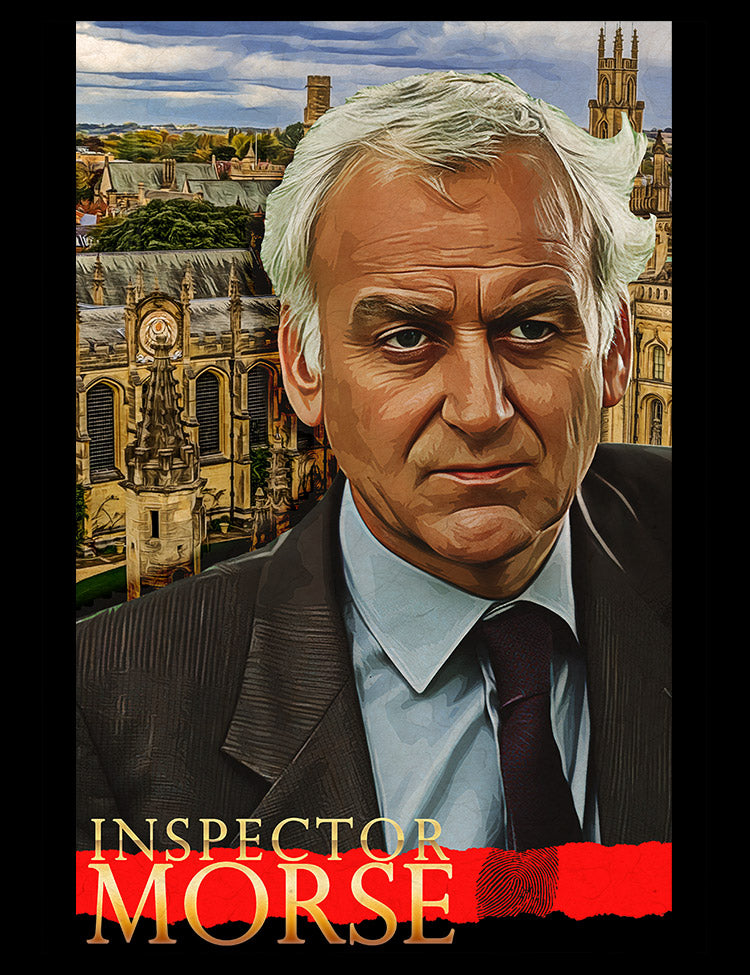
Character, too, stepped forward from the shadows. Detectives were no longer simply functional figures moving plot from A to B. They carried contradictions, habits, flaws, and private burdens that bled into their work. In Inspector Morse, this shift is unmistakable. Morse is brilliant but brittle, cultured yet caustic, a man whose inner life is as compelling as the mysteries he unravels. The crimes unfold with a literary elegance, but it is the character’s introspection, his loneliness and intellectual vanity, that gives the series its lasting resonance.
At the same time, a grittier, more grounded vision of policing began to take hold. Taggart offered something colder and more unvarnished, rooted in the urban sprawl of Glasgow. Here, violence felt closer, motives darker, and justice far less certain. The famous refrain “There’s been a murder” became less a catchphrase and more a grim inevitability, signalling a world where crime was not an interruption but a constant presence. The emphasis shifted toward procedure as lived experience, the day-to-day grind of investigation rather than the theatricality of detection.
What emerged in the mid-to-late 1980s was a genre in flux, caught between tradition and transformation. The episodic model hadn’t disappeared, but it was evolving, absorbing deeper character work, richer atmospheres, and a growing sense of realism. British crime drama was no longer content to simply tell stories. It wanted to inhabit them, to sit with discomfort, and to explore the uneasy spaces between right and wrong.

Key Stylistic Shifts That Redefined the Genre
A. Rise of Realism
As the decade deepened, British crime drama shed its polished veneer and stepped into harsher light. The neat symmetry of beginning, middle, and end began to fracture. Cases no longer wrapped themselves up with comforting finality. Instead, they lingered, unresolved threads trailing behind like loose wires sparking in the dark.
This shift toward realism wasn’t just aesthetic, it was ideological. The detective, once a near-mythic figure of clarity and control, became something far more human. Flawed, fatigued, occasionally fallible. These were not men and women standing above the chaos, they were knee-deep in it. Personal lives bled into professional judgment. Bias, doubt, and emotional strain became part of the investigative toolkit, whether welcome or not.
Institutions, too, lost their untouchable sheen. Police forces were no longer presented as seamless engines of justice but as complex systems shaped by hierarchy, politics, and human weakness. Missteps occurred. Corners were cut. Authority figures could be compromised, constrained, or simply wrong. Crime, in this emerging landscape, was not an anomaly but a symptom, a reflection of deeper fractures within society itself.
The result was a genre that felt heavier, closer to lived experience. Justice became uncertain, outcomes ambiguous, and the line between right and wrong blurred into something far less comfortable. Viewers were no longer just solving puzzles, they were navigating moral terrain.
B. Growth of Serialisation
Running parallel to this rise in realism was a quieter but equally transformative shift in structure. The rigid episodic format began to loosen, making space for stories that stretched across multiple episodes, sometimes across entire seasons. Narrative continuity crept in, subtle at first, then increasingly deliberate.
This move toward serialized and semi-serialized storytelling changed the relationship between audience and drama. Characters could evolve over time, carrying emotional scars, unresolved conflicts, and personal arcs that demanded attention beyond a single episode. Actions had consequences that didn’t conveniently reset by the next instalment. The past lingered, shaping the present in ways that felt authentic and, at times, inescapable.
For viewers, this meant a deeper level of investment. Crime dramas were no longer passive, drop-in experiences but unfolding narratives that rewarded loyalty and attention. Stakes grew heavier because they accumulated. A decision made in one episode might echo weeks later, altering relationships, careers, even identities.
Together, these structural and stylistic changes redefined what British crime drama could achieve. Realism grounded it, serialisation expanded it, and between the two, the genre found a new, more compelling rhythm, one that pulsed with continuity, consequence, and a lingering sense that not everything could, or should, be neatly resolved.

Crime as a Mirror: Social and Political Themes
By the latter half of the 1980s, British crime drama had stopped pretending crime existed in isolation. The chalk outline on the pavement was no longer just the beginning of a puzzle, it was a pressure point, a crack in the surface revealing something larger beneath. The genre turned outward, drawing in the tensions of the time and refracting them through its stories with a sharper, more unsettling clarity.
Class division became one of its most persistent undercurrents. Britain in the 1980s was a nation of widening gaps, where prosperity and deprivation often sat side by side, barely speaking. Crime dramas began to explore this divide not as background texture but as a driving force. Offenders were no longer just shadowy figures lurking at the edges of society, they were often products of it, shaped by economic hardship, limited opportunity, and environments that bred frustration as much as desperation. The detective, in turn, was forced to navigate these spaces, moving between worlds that rarely intersected except in moments of crisis.
Alongside this came the long shadow of industrial decline. As traditional industries faltered and communities were hollowed out, crime narratives absorbed the fallout. Abandoned buildings, struggling towns, and fractured social structures became part of the visual and emotional landscape. The setting itself began to speak, whispering of loss, displacement, and the slow erosion of stability. Crime, in this context, felt less like disruption and more like consequence.
A growing distrust of authority also seeped into the storytelling. Institutions that once stood as pillars of order were now depicted with a degree of suspicion. Police forces, government bodies, and corporate entities were no longer beyond scrutiny. Decisions were influenced by politics, careers, and concealed agendas. The idea that power might operate in self-interest, or worse, in quiet complicity, added a new layer of tension. Justice was no longer guaranteed, and truth was something that had to be wrestled into the light.
Perhaps most significantly, crime itself was reframed. It was no longer treated as a series of isolated incidents but as a symptom of systemic issues. Violence, corruption, and disorder were tied to broader societal pressures, economic imbalance, and institutional failings. Solving the case did not necessarily solve the problem. At best, it offered a temporary resolution, a small victory against a much larger, more complex reality.
Hovering over all of this was the wider anxiety of the era. The 1980s carried a distinct unease, shaped by the spectre of nuclear conflict, the presence of hidden power structures, and a general sense that the world was being steered by forces not easily seen or understood. Crime drama absorbed that mood, translating it into narratives filled with paranoia, ambiguity, and a creeping sense of unease.
In this way, British crime drama became more than entertainment. It became a kind of cultural barometer, measuring the pressures of its time and projecting them onto the screen. Each investigation, each suspect, each uneasy resolution carried echoes of a society grappling with change, uncertainty, and the uncomfortable realisation that the line between order and disorder was far thinner than it once appeared.

Landmark Series That Defined the Shift
If the 1980s rewired British crime drama, these series were the live currents running through it, each carrying a different voltage, each illuminating a different corner of the genre’s transformation. Together, they form a kind of moving map, charting how the familiar became fractured, then reassembled into something richer, darker, and far more daring.
At the threshold stands Juliet Bravo, a series that still carried the DNA of earlier procedurals but quietly altered who got to hold authority. Inspector Jean Darblay wasn’t framed as an exception or a curiosity. She simply was. In doing so, the show expanded the genre’s perspective while maintaining its traditional structure, bridging past conventions with emerging possibilities. It proved that evolution didn’t always arrive with noise. Sometimes it walked in, took a seat, and got on with the job.
Running alongside it, Bergerac offered something deceptively smooth. On the surface, it remained accessible, even comforting, but beneath that lay a subtle shift toward character-led storytelling. Jim Bergerac’s personal struggles threaded through the cases, giving the series a dual heartbeat. Crime was the engine, but character was the fuel. The sunlit backdrop of Jersey masked a more introspective approach, hinting at the emotional depth that would soon become central to the genre.
Then came the grind, the everyday machinery of policing laid bare in The Bill. Emerging from the one-off drama Woodentop, it stripped away glamour and replaced it with routine, repetition, and realism. This was policing as process, not performance. Paperwork, patrols, small decisions with large consequences. It shifted the lens from exceptional cases to lived experience, grounding the genre in a world that felt immediate and recognisable. The station became less a stage and more a system, imperfect and human.
In contrast, Inspector Morse elevated the genre into something almost literary. Here, crime unfolded like a carefully constructed novel, layered with symbolism, intellect, and introspection. Morse himself, brilliant yet brittle, became a study in contradiction. The mysteries mattered, but so did the mind solving them. Atmosphere deepened, pacing slowed, and the audience was invited not just to watch, but to think, to linger, to feel the weight of each revelation.
And then there is Edge of Darkness, the storm rolling in from the horizon. This was crime drama stretched to its outer limits, where investigation collided with conspiracy, politics, and existential dread. The series tapped directly into the anxieties of its time, nuclear fear, hidden networks of power, the sense that truth itself was buried beneath layers of control. It didn’t just tell a story, it unsettled the ground beneath the viewer’s feet.
Each of these series occupies a different point along the spectrum, but together they reveal the full scope of the shift. From procedural roots to psychological depth, from mainstream accessibility to political intensity, the 1980s did not move in a straight line. It expanded outward, experimenting, recalibrating, and ultimately redefining what British crime drama could be.

Why the 1980s Were a Turning Point
The 1980s didn’t so much replace British crime drama as rewire it mid-transmission. One moment, the signal was steady, familiar, built on decades of procedural precision. The next, something new was bleeding through, reshaping the frequency without cutting the line entirely. This was a decade of overlap, where old forms and new ambitions coexisted, collided, and ultimately fused into something more dynamic.
At its core, the era acted as a bridge between two worlds. On one side stood the classic detective format: structured, episodic, and reassuringly contained. On the other, a more modern approach was beginning to take shape, one that embraced ambiguity, character depth, and narrative sprawl. The brilliance of the 1980s lies in how it connected these modes rather than choosing between them. It allowed audiences to step gradually from certainty into complexity, from resolution into reflection.
In doing so, it quietly recalibrated expectations. Viewers who once tuned in for neat conclusions began to demand something richer. They wanted stories that lingered, characters who evolved, and worlds that felt authentic rather than constructed. Realism became less of an experiment and more of a standard. Emotional continuity, moral ambiguity, and social context were no longer optional extras, they were essential ingredients. Crime drama was no longer just about solving a case. It was about understanding it, and sometimes, accepting that understanding wouldn’t bring closure.
This shift also carried the genre into new cultural territory. What had once been seen as dependable, even formulaic television began to attract critical attention and respect. Writers and directors treated it as a space for serious storytelling, capable of engaging with complex themes and reflecting the anxieties of contemporary Britain. Crime drama became a vehicle for commentary as much as entertainment, a place where questions about power, justice, and society could be explored with both nuance and urgency.
By the end of the decade, the transformation was complete. The foundations of the past were still visible, but they now supported something far more ambitious. The 1980s didn’t just move British crime drama forward, it expanded its horizons, raising the bar for what audiences expected and what the genre itself could deliver.

Legacy: Foundations of Modern British Crime Drama
What the 1980s set in motion didn’t fade with the decade, it embedded itself into the DNA of British television. The shows that followed in the 1990s and beyond didn’t reinvent the genre from scratch, they inherited a newly expanded toolkit. Realism was no longer a stylistic choice but an expectation. Character depth wasn’t a bonus feature, it was the engine. And crime itself had permanently shifted from isolated incident to social symptom.
The influence is unmistakable. Later series leaned into longer narrative arcs, deeper psychological exploration, and a willingness to leave questions unresolved. Detectives became more complex, often carrying personal fractures that mirrored the cases they pursued. Institutions were scrutinised rather than trusted, their inner workings exposed with a candour that would have felt radical a decade earlier. The audience, now accustomed to this richer storytelling, demanded nothing less.
Three themes, in particular, endured and evolved. Moral ambiguity replaced moral certainty, creating worlds where right and wrong blurred into uneasy shades of grey. Institutional critique became a defining feature, with systems of power examined as closely as the crimes themselves. And psychological depth turned characters into studies rather than archetypes, inviting viewers to engage not just with what happened, but with why it mattered.
In this sense, the 1980s function as a blueprint for what would later be recognised as prestige crime television. The darker tone, the layered narratives, the emphasis on atmosphere and internal conflict, all of it can be traced back to this period of transformation. Modern British crime drama, with its brooding landscapes and intricate storytelling, still walks the path first carved during those years. The aesthetic may have sharpened, the production values may have grown, but the foundation remains unmistakably the same.

Conclusion: The Decade That Changed the Game
Looking back, the evolution of British crime drama in the 1980s reads less like a gradual shift and more like a quiet revolution. The decade began with familiar forms, structured, contained, and comfortably predictable. It ended with something far more complex: a genre unafraid of ambiguity, attuned to social realities, and willing to challenge both its characters and its audience.
The transformation touched every aspect of the form. Storytelling grew more ambitious, stretching beyond episodic boundaries into layered, evolving narratives. Characters gained depth, becoming flawed, introspective, and deeply human. Tone darkened, realism intensified, and the world on screen began to reflect the tensions and uncertainties of the world beyond it. Crime was no longer a puzzle to be solved in isolation, it was a window into the broader forces shaping society.
What makes the 1980s so significant is not just what it produced, but what it made possible. It expanded the boundaries of the genre, opening space for experimentation, complexity, and cultural relevance. It invited audiences to look beyond the surface of the story and engage with the deeper questions beneath it.
And that legacy endures. Every brooding detective, every morally tangled investigation, every slow-burn narrative that refuses easy answers carries a trace of that decade’s influence. The 1980s didn’t just change British crime drama. It redefined its potential, turning it from a reliable format into a powerful form of storytelling that continues to evolve, unsettle, and captivate.