
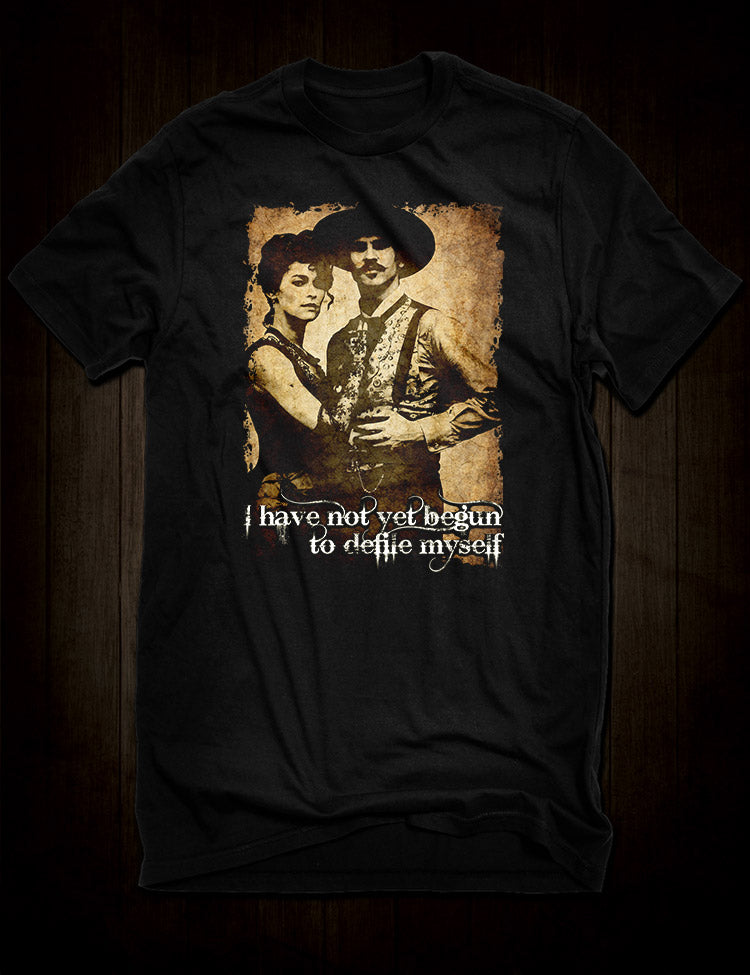



James M. Cain T-Shirt

JAMES M. CAIN T-SHIRT
The Writer Who Put Desire, Crime and Bad Decisions on the Same Road
James M. Cain did not need private detectives, elaborate mysteries or criminal masterminds. Give him a roadside diner, an insurance policy, a frustrated husband, an ambitious wife or somebody who wanted one thing a little too badly, and the machinery was already running. His best fiction works with the ruthless simplicity of a trap: ordinary people discover an opportunity, convince themselves they can control what happens next, and learn otherwise.
Born in Annapolis, Maryland, in 1892, Cain came to fiction comparatively late. He worked as a journalist, wrote editorials for the New York World, briefly served as managing editor of The New Yorker and moved to Hollywood in 1931. The film industry never made him the screenwriter he might have expected to become, but California gave him something more valuable: the landscape, occupations and overheated ambitions that would help shape his fiction.
"They threw me off the hay truck about noon."
That opening sentence introduced The Postman Always Rings Twice in 1934. Frank Chambers, an itinerant drifter, arrives at a roadside establishment and becomes involved with Cora, the owner's wife. Cain dispenses with lengthy preparation. Attraction becomes conspiracy; conspiracy becomes murder; and every apparent escape merely tightens the structure around the characters. The novel's compressed language and first-person urgency helped establish Cain as one of the central figures associated with American hard-boiled and noir fiction, although he was never especially comfortable with such classifications.
Double Indemnity, first published in serial form in 1936, refined the formula still further. Insurance salesman Walter Huff becomes involved with Phyllis Nirdlinger and a scheme to murder her husband while exploiting the double-indemnity clause in his accident policy. Cain understood that the most interesting criminal plots are often created not by professional criminals but by otherwise recognisable people who become convinced that intelligence, desire or technical knowledge will protect them from consequences.
Hollywood quickly recognised the cinematic possibilities. Billy Wilder's 1944 adaptation of Double Indemnity, with a screenplay by Wilder and Raymond Chandler, became one of the defining films associated with film noir. Mildred Pierce, published by Cain in 1941, reached cinemas in 1945 with Joan Crawford, while MGM's long-delayed adaptation of The Postman Always Rings Twice followed in 1946 with Lana Turner and John Garfield. Cain's relationship with film noir is therefore slightly peculiar: much of the fiction came first, yet the films became so influential that their visual language now colours the way generations of readers imagine his work.
Mildred Pierce also demonstrates why reducing Cain to murder stories misses much of what made him distinctive. Its central conflicts concern money, work, social aspiration, motherhood and emotional dependence rather than a conventional criminal plot. Cain repeatedly returned to Americans trying to reinvent themselves through talent, business, sex, marriage or sheer determination. The resulting disasters could be violent, but the engine was usually desire.
Cain continued publishing for decades, but his extraordinary run from the 1930s through the 1940s secured his reputation. Alongside Dashiell Hammett and Raymond Chandler, he became inseparable from discussions of twentieth-century American crime writing, while remaining markedly different from both. Cain was less interested in the detective looking into the darkness than in the people already standing inside it.
💬 FREQUENTLY ASKED QUESTIONS (FAQs)
Q1: Was James M. Cain a detective novelist?
A1: Not in the conventional sense. Cain generally avoided recurring detectives and often told stories from the viewpoint of people involved directly in crimes, affairs, betrayals and schemes rather than those investigating them.
Q2: Why is James M. Cain associated with film noir?
A2: Several major films associated with noir were adapted from his fiction, particularly Double Indemnity and The Postman Always Rings Twice. His themes of fatal attraction, compromised protagonists and irreversible choices also fitted naturally with the developing noir tradition.
Q3: Which James M. Cain book should a new reader start with?
A3: The Postman Always Rings Twice is the most concise introduction to his style, while Double Indemnity develops his fascination with criminal calculation. Mildred Pierce offers a broader picture of Cain's interests beyond murder fiction.