

Bloody Mary: Why the Mirror Legend Is Older Than the Ghost
Everybody knows the rules.
Find a mirror. Turn off the lights. Say her name three times.
Then wait for something unpleasant to appear behind the glass.
The Bloody Mary mirror legend has terrified generations of children, usually in bathrooms where the most immediate danger is somebody switching the light on and spoiling the atmosphere.
Depending on who tells the story, Mary might be a murdered woman, an executed witch, a grieving mother or a bloodthirsty spirit with an unfortunate interest in children's faces.
Her identity changes. Her alleged methods vary. Even the number of times her name must be repeated is negotiable.
But the mirror remains.
And that is where the story becomes interesting.
Before Bloody Mary, There Was Halloween Fortune-Telling
Long before children began summoning murderous apparitions in school bathrooms, young women were using mirrors to discover something considerably more appealing.
The identity of their future husbands.
Mirror divination was part of the folklore surrounding Halloween in Britain and North America.
One traditional method involved looking into a mirror by candlelight, sometimes after walking backwards up a staircase.
If the ritual worked, the face of a future husband would supposedly appear.
There was, naturally, a less encouraging possibility.
Seeing a skull or the figure of Death could mean that marriage would never happen because the participant would die first.
Victorian and Edwardian Halloween customs frequently combined romantic curiosity with the possibility of supernatural punishment.
Even courtship apparently required a little mortal terror.
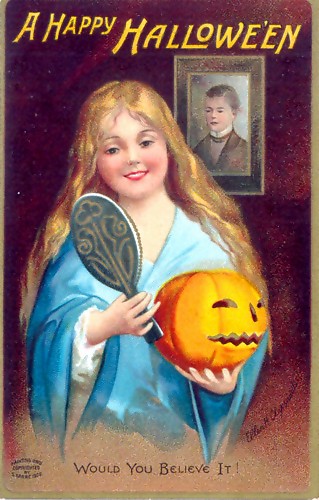
The tradition was sufficiently familiar to appear on commercially produced Halloween greeting cards.
A 1904 illustration by Ellen Clapsaddle depicts a young woman holding a hand mirror while the image of a man appears behind her.
It is a remarkably direct ancestor of the modern bathroom ritual.

How Did the Bloody Mary Mirror Legend Begin?
The familiar Bloody Mary ritual appears to have developed into its recognisable modern form during the twentieth century.
By the late 1960s and 1970s, folklorists were documenting versions performed by children and adolescents.
The romantic prediction had largely disappeared.
Instead of asking a mirror to reveal a future husband, participants attempted to summon a frightening female presence.
The ritual became a test of courage.
One child entered a darkened bathroom. Others waited outside, offering encouragement of the least reassuring kind.
The name might be Bloody Mary, Mary Worth or another local variation.
Sometimes the chant required three repetitions. Other versions demanded considerably more.
There was no definitive procedure because the story belonged to oral folklore rather than a written supernatural instruction manual.
The important elements were anticipation, darkness, repetition and the possibility that something might appear.
Folklorist Alan Dundes examined the ritual in his 1998 essay Bloody Mary in the Mirror, interpreting its imagery in relation to anxieties surrounding adolescence and bodily change.
That is one interpretation rather than a universally accepted explanation.
The game also functions as a social ritual in which children test fear, challenge one another and discover how easily imagination can overpower common sense.
Was Bloody Mary a Real Person?
The most frequently suggested historical identity is Mary I of England.
Her persecution of Protestants during the sixteenth century earned her the notorious nickname Bloody Mary.
It is an attractive explanation.
Unfortunately, sharing a name does not establish a historical connection.
There is no convincing documentary trail linking the Tudor queen directly to the modern mirror ritual.
Other explanations identify Mary as an executed witch, a murdered young woman or a mother whose children died tragically.
These accounts generally belong to the legend itself rather than independently documented history.
Folklore frequently creates biographies for characters who originally had none.
A mysterious name acquires a tragic past. The tragic past gains a location. Eventually somebody announces that the whole thing happened in a particular village.
By then, the story has acquired the appearance of history without necessarily acquiring any evidence.


Why Do People See Faces in Dark Mirrors?
The most unsettling aspect of the Bloody Mary legend is that something genuinely strange can happen when people stare at their reflections in dim light.
Not necessarily something supernatural.
Something psychological.
In 2010, psychologist Giovanni B. Caputo published research examining what happens when people observe their own faces in mirrors under low illumination.
Participants reported striking distortions.
Some perceived unfamiliar faces. Others described animals, monstrous figures or features resembling deceased relatives.
The phenomenon became known as the strange-face-in-the-mirror illusion.
Under poor lighting, facial details become less stable and the visual system can interpret ambiguous information in unexpected ways.
Prolonged staring may make an entirely ordinary reflection seem unfamiliar.
Combine that with a dark room, a frightening story and the expectation that a ghost is about to appear, and the conditions become particularly effective.
The experiment does not establish that every reported Bloody Mary experience has the same explanation.
But it demonstrates that the human visual system can produce remarkably convincing distortions without supernatural assistance.
Which is arguably more disturbing.
The Ghost Who Never Needed a Ghost Story
The Bloody Mary mirror legend survives because it requires almost nothing.
No elaborate equipment. No special location. No expensive theatrical effects.
Just a mirror, a darkened room and somebody willing to be frightened.
Its older connection to Halloween fortune-telling explains why mirrors became associated with mysterious faces.
Children's folklore transformed that tradition into a supernatural challenge.
Psychology helps explain why the experience can occasionally feel more convincing than expected.
The result is a remarkably durable urban legend.
Every generation inherits the basic rules, changes a few details and passes the story along.
Somewhere, another child is standing in front of a bathroom mirror, wondering whether saying the name one more time is a good idea.
The answer probably depends on how much they trust their own reflection.
Explore more supernatural folklore through Hellwood's Paranormal & Unexplained Collection, Occult T-Shirts and Witchcraft & Magick Collection.

BLOODY MARY LEGEND T-SHIRT
Say her name. Watch the mirror.
A Hellwood tribute to the enduring Bloody Mary legend, inspired by the supernatural folklore that transformed an ordinary reflection into one of childhood's most unsettling rituals.
For those who prefer their folklore with a little darkness and a considerable amount of uncertainty.
VIEW THE BLOODY MARY LEGEND T-SHIRT