





Why Did Arthur Rimbaud Stop Writing Poetry at 20?
The most unsettling thing about Arthur Rimbaud is not that he wrote poetry like a man trying to dismantle language with his bare hands.
It is that he stopped.
By his early twenties, the French teenager who had scandalised Parisian literary society was finished with the art that would make him famous.
He did not spend the following years explaining himself in interviews. He travelled, took jobs, traded goods and wrote letters about money.
Meanwhile, readers were still trying to work out what he had done to poetry.
So why did Arthur Rimbaud stop writing?
The irritatingly appropriate answer is that nobody knows for certain.
A Teenage Poet with an Unreasonable Ambition
Born in Charleville in 1854, Rimbaud was writing accomplished verse while still at school.
He ran away from home repeatedly, wandered through a France unsettled by war and political upheaval, and developed a spectacular dislike of respectable expectations.
In 1871, he outlined his idea of the poet as a visionary: someone who would deliberately disrupt ordinary perception to discover a new language.
In a letter to Paul Demeny, he declared, "I is another."
It was not the sort of career advice likely to impress a provincial headmaster.
His poem The Drunken Boat sent an imaginary vessel drifting through an extravagant succession of visions. The language was vivid, unruly and unlike the careful verse expected of a well-behaved schoolboy.
He was sixteen when he contacted the older poet Paul Verlaine, who invited him to Paris.
Their volatile relationship would take them through France, Belgium and England, and eventually into a police investigation.


A Gunshot and a Book Left in a Printer's Storeroom
On 10 July 1873, during an argument in Brussels, Verlaine fired a revolver at Rimbaud.
One bullet struck the younger man's wrist.
Verlaine was convicted of wounding him and sentenced to two years in prison.
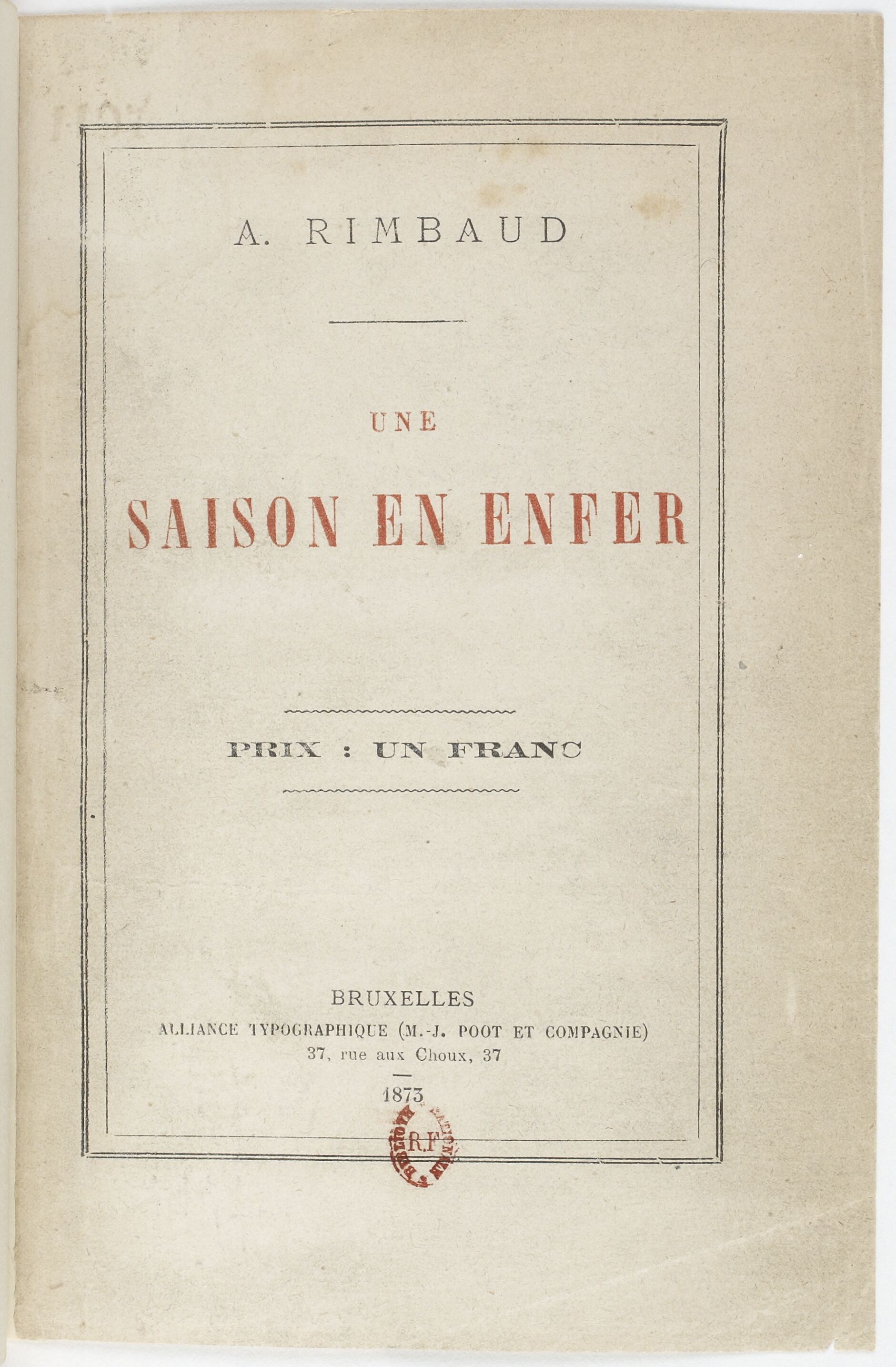
Rimbaud returned to the family farm at Roche and completed A Season in Hell, a ferocious mixture of prose poetry, confession, religious argument and literary self-examination.
It was printed in Brussels in 1873 at his own expense.
The book was hardly a publishing triumph: he collected only a few copies, while most of the print run remained with the printer after the bill went unpaid.
There is a romantic story that Rimbaud destroyed the entire edition in disgust.
In reality, a substantial stock was discovered in the printer's premises in 1901.
The books had been sitting there while a legend grew around their supposed destruction.
And the book was not quite his final word.
At least some of the prose poems later collected as Illuminations were written in 1874, perhaps even 1875.
The chronology matters: he did not simply put down his pen after the Brussels shooting.

The Poet Becomes a Trader
By around 1875, however, the poetry appears to stop.
Rimbaud was only twenty or twenty-one.
What followed looks like an attempt to live several unrelated lives in rapid succession.
He travelled across Europe, enlisted in the Dutch colonial army and deserted after reaching Java. He worked in Cyprus and eventually moved towards the Red Sea.
By 1880 he was working in Aden and Harar, in what is now Ethiopia, where his business concerned coffee, hides and other goods.
He later pursued independent trading ventures, including an unsuccessful arms deal.
His surviving correspondence from this period is full of practical matters: shipments, expenses, opportunities, health, the difficulty of making a living.
Poetry scarcely enters the picture.
The young man who wanted to remake human perception was now worrying about accounts.
Anyone who has ever exchanged an artistic ambition for a spreadsheet may recognise the sensation, though the geography was more adventurous.
Why Did Rimbaud Stop Writing Poetry?
There is no reliable farewell speech in which Rimbaud explains the decision.
Scholars have proposed disillusionment, exhaustion, a rejection of literary society and a restless desire for other experiences.
None can be established as the single answer.
The ending of A Season in Hell sounds like a goodbye, but the later Illuminations complicate the neat story of a poet who renounced art in one dramatic instant.
While Rimbaud worked abroad, Verlaine helped bring his writing to a wider audience.
He celebrated the younger poet in The Accursed Poets in 1884; Illuminations appeared in print in 1886.
Rimbaud was becoming a literary legend while showing little visible interest in participating.
Illness eventually brought him back to France. His leg was amputated in Marseille in 1891, and he died there that November, aged thirty-seven.
The silence remains the most provocative part of his biography.
Most writers dream of being remembered for something they have made.
Rimbaud made something extraordinary, then walked away before the applause began.
Discover Hellwood's Arthur Rimbaud T-Shirt, celebrating one of literature's most uncompromising and mysterious figures.
For more literary outsiders, explore the Poetry T-Shirt Collection, the Famous Writers T-Shirt Collection and Hellwood's Literary Quotes T-Shirt Collection.

ARTHUR RIMBAUD T-SHIRT
Five years of poetry. A lifetime of legend.
A Hellwood tribute to Arthur Rimbaud, the visionary French poet whose extraordinary teenage literary career helped transform modern poetry before he abandoned writing altogether.
Featuring a distressed portrait of Rimbaud with expressive typography inspired by his restless and uncompromising spirit.
VIEW THE ARTHUR RIMBAUD T-SHIRT