






The Bell Witch: The True History Behind America’s Famous Ghost Story
Most ghosts are content with footsteps, cold spots and appearing inconveniently at the end of corridors. The Bell Witch was apparently something of an overachiever.
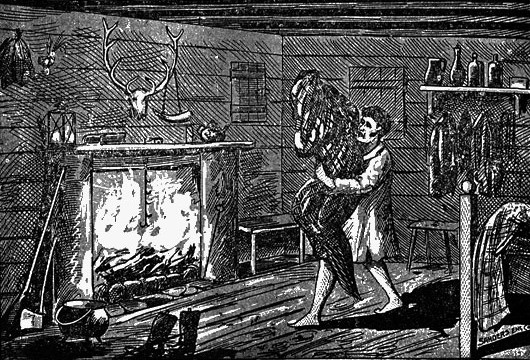
According to one of America’s most enduring supernatural legends, an invisible entity tormented the family of farmer John Bell near what is now Adams, Tennessee, during the late 1810s. It knocked on walls, pulled hair, slapped children, quoted Scripture, sang hymns, impersonated neighbours and eventually claimed responsibility for Bell’s death.
The story behind Hellwood’s Bell Witch T-Shirt sounds remarkably detailed for events more than two centuries old. That is where things become interesting, because the famous haunting and the surviving history of it are not quite the same thing.
Something Arrives at the Bell Farm
John and Lucy Bell moved from North Carolina to Middle Tennessee in 1804, establishing a prosperous farm beside the Red River. The Tennessee Encyclopedia places the beginning of the strange disturbances around 1816.
The legend grew gradually. Strange animals were supposedly seen around the property. Knocking and scratching appeared inside the house. Bedclothes were pulled away during the night. Eventually the presence developed a voice and acquired the name “Kate”.
John Bell and his daughter Betsy became its favourite targets. Other family members, neighbours and enslaved workers were later incorporated into the story, turning what began as a domestic haunting into something approaching frontier theatre.

Did the Bell Witch Really Kill John Bell?
The darkest part of the legend concerns John Bell himself. His health deteriorated and he died on 20 December 1820. Later accounts claimed that a mysterious vial of liquid was discovered near his medicine and that the entity announced it had poisoned him.
There is no historical evidence establishing supernatural murder. The episode survives as part of the legend rather than a medically documented cause of death.
That distinction applies to much of the story. The Tennessee State Museum explicitly describes the Bell Witch as folklore and notes that stories are passed between generations orally. Details accumulated, changed and became attached to real people and places.
The famous tale that Andrew Jackson visited the farm is a good example. It has become one of the best-known Bell Witch anecdotes, yet its surviving written source comes from decades later. Ghost stories, like politicians, generally improve their biographies with repetition.
The Book That Made the Witch Famous
The single most important object in the Bell Witch story appeared not in 1817 but in 1894.
Newspaper editor Martin Van Buren Ingram published An Authenticated History of the Famous Bell Witch, the first full-length account of the haunting. Ingram said his narrative drew partly upon a manuscript attributed to John Bell’s son Richard and upon family and community recollections.
By then, more than seventy years had passed since John Bell’s death.
This does not make the story worthless. Quite the opposite: Ingram’s book preserves a remarkable body of nineteenth-century Southern folklore. But it means that reading it as though it were a police report written during the haunting is a mistake. The Tennessee State Museum now uses the Bell Witch specifically to explore how people attempted to explain strange experiences and how real social history becomes entangled with folklore.
From Family Haunting to Tourist Attraction
The legend did something else unusually early: it attracted visitors.
The National Park Service records that people began travelling to the area soon after the first reported sightings, hoping to encounter the witch themselves. Bell Witch Cave, on land associated with the Bell property, eventually developed into a tourist destination and was listed on the National Register of Historic Places in 2008 specifically for its significance to recreation and tourism.
The story continued mutating. Books, plays, films and television carried it far beyond Tennessee. In 1947, composer Charles Faulkner Bryan even brought his Bell Witch folk cantata to Carnegie Hall, helping turn what had remained largely regional folklore into a story for a national audience. :contentReference[oaicite:3]{index=3}
That afterlife explains why the Bell Witch fits so neatly alongside Hellwood’s Paranormal & Unexplained T-Shirts, Witchcraft & Magick T-Shirts and American History T-Shirts. The case occupies all three territories at once: supernatural claim, folk tradition and genuine cultural history.
Whether anything unexplained actually walked through the Bell farmhouse is impossible to establish two centuries later. What unquestionably survived was the story — and in the long history of ghosts, that is usually the part that refuses to die.

THE BELL WITCH T-SHIRT
A Hellwood tribute to the invisible Tennessee troublemaker whose alleged talents included talking, shape-shifting, assault, theology and becoming considerably more famous after everyone involved was dead.