
Decoding the Surrealism: A Deep Dive Into the Imagery and Meaning of David Lynch's Films

David Lynch Movies Explained
A clear, conversational guide to the recurring symbols, dreams, doubles, red rooms, highways, insects, industrial noise, small-town rot and fractured identities that make David Lynch’s films feel so strange, so funny, so frightening and so unforgettable.
What Do David Lynch's Movies Usually Mean?
David Lynch’s films usually explore the hidden violence, desire, trauma and mystery beneath ordinary American life. His surreal images rarely have one fixed answer; instead, they work like emotional clues, turning dreams, doubles, strange rooms, music, curtains, roads and distorted identities into a language of fear, longing and revelation.
In simple terms, Lynch’s movies are about the moment when the surface world cracks. A suburban lawn hides criminal rot, a Hollywood dream becomes a nightmare, a detective story becomes a spiritual maze, and a familiar face begins to look like a stranger in the mirror.

What Does “Lynchian” Mean?
“Lynchian” describes a mood where the familiar turns quietly wrong. It is not just surrealism for the sake of weirdness. A Lynchian scene often begins with something ordinary: a diner, a living room, a school photograph, a song on a stage, a highway at night, a suburban fence, a cup of coffee. Then the air curdles.
The word has become shorthand for a specific mix of dream logic, emotional dread, black comedy, sexual anxiety, Americana, noir, old Hollywood glamour, industrial sound design and sudden eruptions of violence. Lynch’s world is not random. It is precise, but its precision belongs to mood rather than plot mechanics.
A traditional thriller asks, “Who did it?” A Lynch film asks a more dangerous question: “What kind of world would produce this fear in the first place?”
What Are the Core Elements of a Lynchian Story?
- A normal surface: small towns, clean houses, police procedures, auditions, diners, family homes.
- A hidden underworld: crime, abuse, sexual threat, guilt, occult forces, Hollywood exploitation, spiritual corruption.
- A split identity: doubles, alternate selves, amnesia, role-playing, masks, transformations.
- A dream structure: scenes connect by emotional logic rather than ordinary cause and effect.
- A sound world: drones, electrical hums, old songs, nightclub performances and sudden silence.
- A moral wound: beneath the strangeness is often a story about pain, especially hidden or denied pain.
Why Are Dreams So Important in David Lynch Films?
Dreams matter in David Lynch’s films because they reveal truths that ordinary waking life tries to hide. His dream scenes are not usually “fake” scenes that can be dismissed. They are emotional x-rays: they show guilt, terror, desire, memory and identity in symbolic form.
In Lynch’s work, dreams are not separate from reality. They leak into it. A dream may explain a murder, disguise a trauma, invent a fantasy identity or reveal that a character’s sense of self is already unstable. This is why trying to divide a Lynch story into “real scenes” and “dream scenes” can flatten the experience. The more useful question is: what emotional truth does the dream expose?
How Does Dream Logic Work in Lynch's Films?
Dream logic allows Lynch to connect images by feeling. A blue key, a red curtain, a white horse, a severed ear, a nightclub performance or a flickering lamp may not behave like clues in a detective novel. They behave like recurring thoughts inside a frightened mind.
This is why Lynch’s films often feel intuitive before they feel explainable. You may not know exactly what a scene “means” on first viewing, but you understand its emotional temperature. You feel the danger before the plot confirms it.

What Does Twin Peaks Symbolism Mean?
Twin Peaks uses symbols such as owls, red curtains, the Black Lodge, coffee, cherry pie, electricity and Laura Palmer’s photograph to explore the battle between everyday innocence and buried evil. Its central mystery is not only “Who killed Laura Palmer?” but “What has this town refused to see?”
Created by David Lynch and Mark Frost, Twin Peaks begins as a murder mystery, but it expands into a symbolic map of grief, violence, spiritual danger and small-town denial. The show’s most famous images are powerful because they work on several levels at once: plot clue, supernatural sign, emotional wound and pop-cultural icon.
What Do the Owls Mean in Twin Peaks?
The phrase “The owls are not what they seem” suggests that nature itself may be a disguise. In the world of Twin Peaks, the woods are not just scenic background. They are a threshold. Owls become watchers, messengers or masks for forces moving between the visible town and the darker spiritual spaces around it.
On a simple level, the owls mean: do not trust appearances. The symbol fits the entire series. A friendly town hides abuse. A respectable family hides horror. A comforting diner exists near a supernatural wound. The owl is the perfect Lynchian emblem because it looks natural while hinting at something unnatural.
What Does the Red Room Mean in Twin Peaks?
The Red Room is one of the clearest examples of Lynch’s symbolic architecture. It is part dream space, part waiting room, part spiritual courtroom and part theatre. Its red curtains make it feel like a stage, which matters because Twin Peaks repeatedly asks whether people are performing normality while hiding something monstrous.
The zigzag floor, backward speech, statues, curtains and strange calm create a place outside ordinary time. Characters do not simply enter a room; they enter a symbolic system where identity, guilt and fate can be rearranged.
What Does Laura Palmer Symbolize?
Laura Palmer symbolizes the gap between public image and private suffering. Her homecoming-queen photograph gives the town a clean, mournable icon, but the series gradually reveals a person who was complex, wounded, secretive, brave and trapped.
That is one reason Twin Peaks: Fire Walk With Me is so important. It moves Laura from symbol to subject. The original series often circles around her absence; the film forces the viewer to confront her lived terror, not just the mystery built around her death.
Explore the Twin Peaks Side of Hellwood
If the owls, curtains and Black Lodge have lodged themselves somewhere permanent in your skull, browse the David Lynch T-Shirt Collection, including designs inspired by The Owls Are Not What They Seem and Fire Walk With Me.

What Does Blue Velvet Mean?
Blue Velvet is about the horror beneath the polished surface of American suburbia. Its central image is the severed ear found in a field: a grotesque opening into a hidden world of sexual violence, voyeurism, fear and power.
The film begins with bright lawns, flowers and white fences, then descends into the criminal underworld of Lumberton. That descent is the structure of the film. Jeffrey Beaumont does not simply solve a mystery; he discovers that the adult world is much darker than the suburban mythology around him allowed.
What Does the Severed Ear Mean in Blue Velvet?
The severed ear is a portal. It pulls Jeffrey, and the viewer, from the safe surface of the town into its hidden interior. An ear is also an organ of listening, and Blue Velvet is full of overheard sounds, secret performances and private scenes witnessed by someone who should not be there.
The image says: if you listen closely enough to the perfect town, you will hear something terrible underneath.
What Does Frank Booth Represent?
Frank Booth represents uncontrolled appetite, intimidation and the violent collapse of adult authority. He is not just a villain in a criminal plot. He is the film’s nightmare version of masculinity: needy, theatrical, cruel, infantile and dangerous.
Frank’s obsession with ritual, song, language and domination makes him more than a gangster. He is a force of corruption. His presence turns rooms into stages and ordinary phrases into threats.
Why Is Music So Important in Blue Velvet?
Music in Blue Velvet exposes the emotional contradiction at the heart of Lynch’s cinema. A beautiful song can be sincere and sinister at the same time. It can offer comfort while also trapping a character inside memory, fantasy or danger.
Lynch often uses music this way. A song is never only decoration. It becomes evidence.
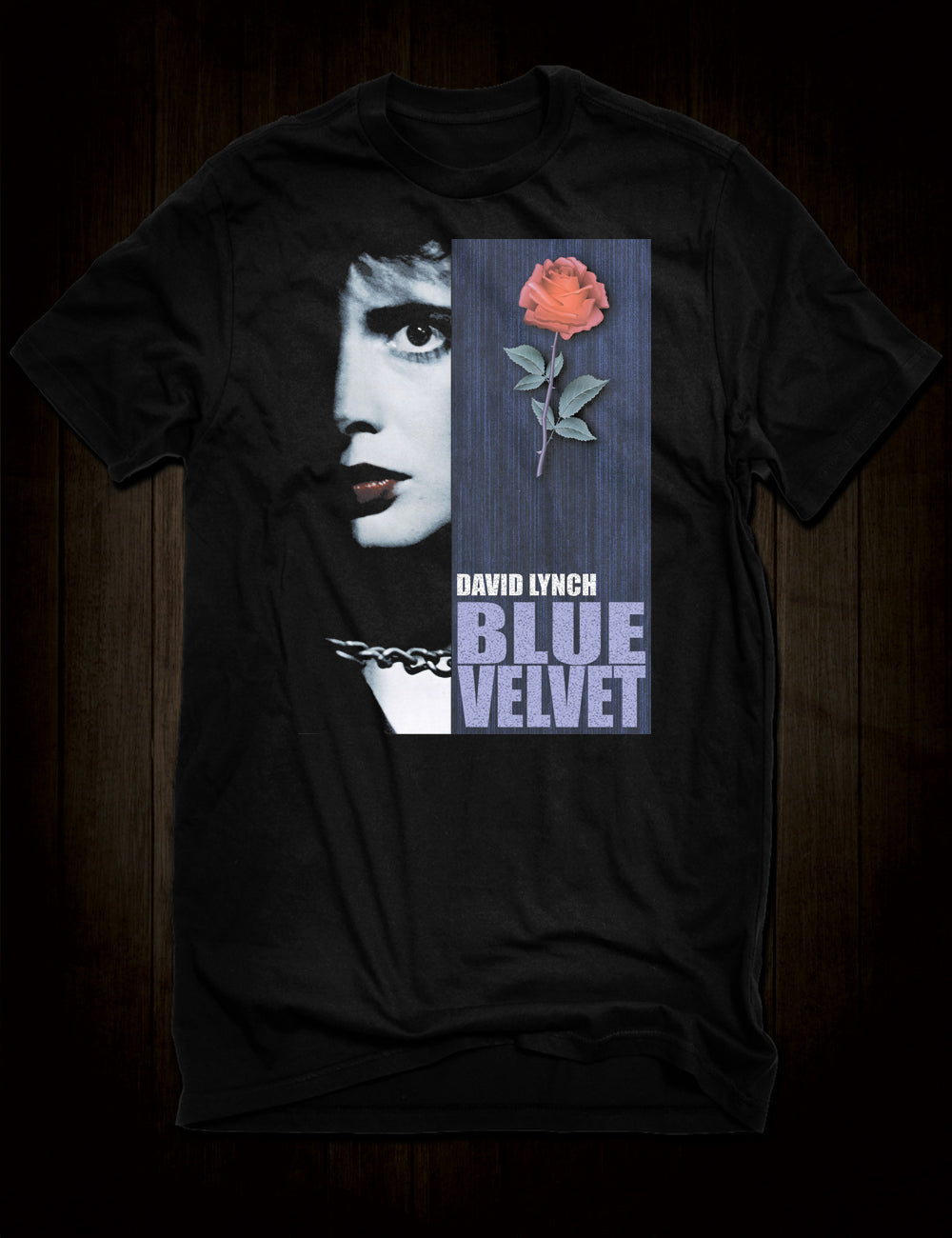
Blue Velvet T-Shirt
For fans of Lumberton’s velvet-black underbelly, see Lynch's Blue Velvet T-Shirt in the Hellwood David Lynch collection.

What Does Mulholland Drive Mean?
Mulholland Drive is usually understood as a fractured Hollywood nightmare about desire, failure, jealousy and fantasy identity. One part of the film plays like an idealized dream of success and romance; another reveals the pain, humiliation and guilt that dream was built to conceal.
The film’s power comes from the way it turns Hollywood itself into a dream machine. Auditions, casting rooms, glamorous apartments, mysterious clubs and studio power brokers all become part of a system where identity can be invented, sold, destroyed or mourned.
Who Are Betty and Diane in Mulholland Drive?
Betty can be read as Diane’s dream-self: hopeful, talented, adored and newly arrived in Hollywood. Diane is the damaged reality behind that fantasy: disappointed, jealous, grieving and implicated in violence. The film does not hand this to the viewer like a labelled folder, but the emotional pattern is clear.
Betty is the Hollywood dream. Diane is what happens when the dream fails and the dreamer cannot survive the knowledge.
What Does the Blue Box Mean in Mulholland Drive?
The blue box is a threshold between fantasy and truth. When it opens, the film’s dream arrangement collapses and the hidden emotional reality comes forward. Like many Lynch objects, it is simple, strange and impossible to reduce to a single mechanical explanation.
The blue box means the dream has a locked centre. Once opened, the fantasy cannot protect the dreamer anymore.
What Does Club Silencio Mean?
Club Silencio is the film’s manifesto. It tells the audience that performance can feel real even when we know it is constructed. “No hay banda” is not just a trick; it is a warning about cinema, identity and emotional illusion.
The scene is devastating because it does not say art is fake and therefore meaningless. It says art is fake and still powerful enough to break your heart. That is pure Lynch: the illusion is exposed, but the feeling remains.
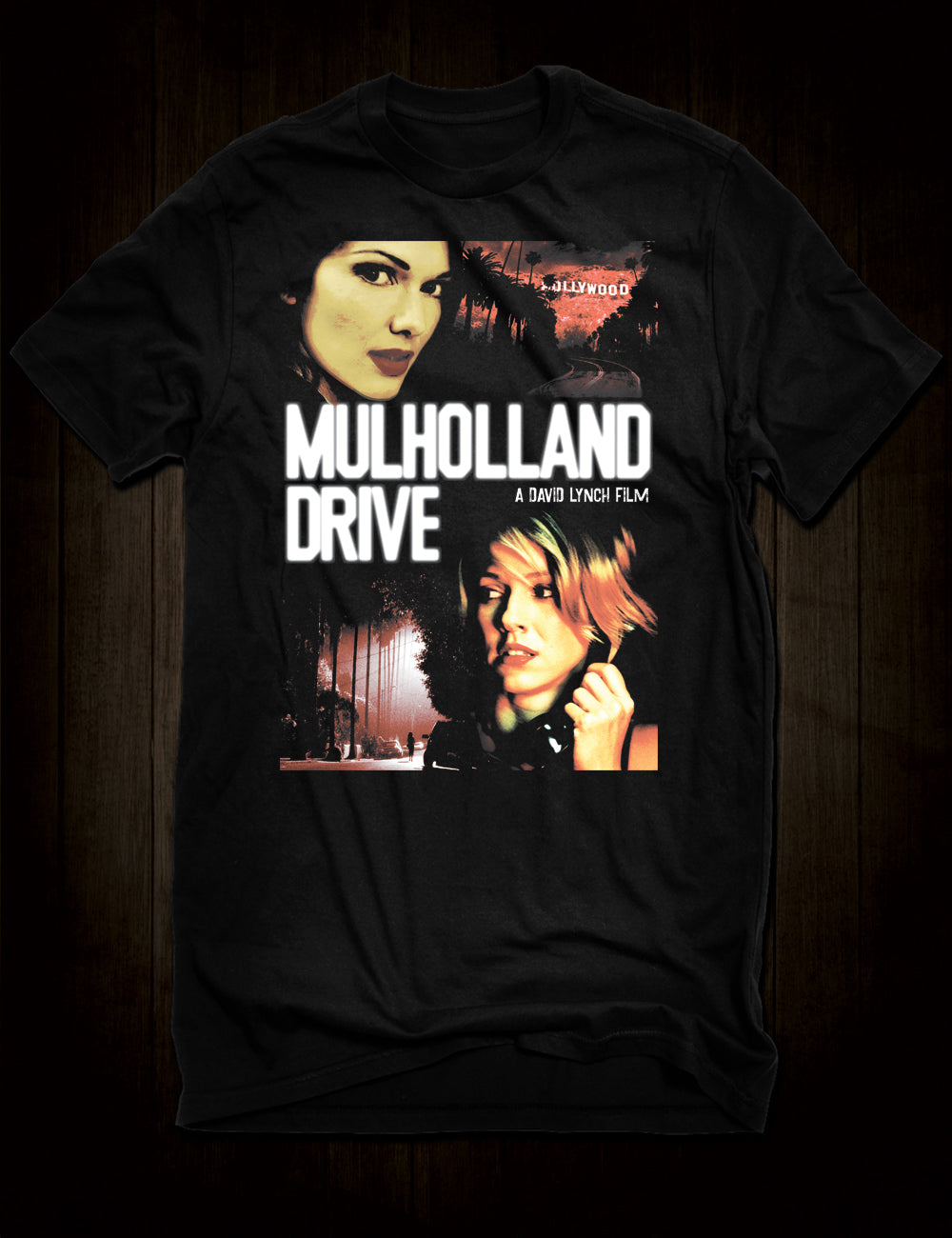
Mulholland Drive T-Shirt Links
Follow the blue-lit road into Hellwood’s Lynch selection with the Mulholland Drive Poster T-Shirt, Mulholland Drive T-Shirt, and Winkies Mulholland Drive T-Shirt.

What Does Lost Highway Mean?
Lost Highway is about guilt, denial and identity collapse. Its story follows Fred Madison, a musician whose life fractures into another persona, Pete Dayton, after a murder and a series of impossible events. The film works like a noir nightmare built around repression.
Lynch does not present Fred’s transformation as a tidy plot twist. It feels more like a psychic escape hatch. A man unable to face what he has done or what he desires invents another route, another body, another story. But the road loops back. The highway is lost because there is no clean exit from the self.
What Does the Mystery Man Mean in Lost Highway?
The Mystery Man represents surveillance, guilt and the terror of being known. His impossible presence suggests that Fred cannot hide from the truth. He is inside the house and outside it. He is at the party and on the phone. He is witness, demon, camera, conscience and void.
The character’s horror lies in his calm certainty. He does not chase Fred. He waits for Fred’s reality to incriminate itself.
What Does the Highway Symbolize in Lost Highway?
The highway symbolizes escape without destination. It is movement stripped of progress. Lynch returns to road imagery often because roads promise freedom, but in his darker work they also suggest repetition, loneliness and the impossibility of outrunning memory.
In Lost Highway, the road is not a route out of the nightmare. It is the shape of the nightmare.

Lost Highway T-Shirt Links
For the blacktop end of Lynch’s neo-noir universe, browse the Lost Highway T-Shirt and Lost Highway Mystery Man T-Shirt.

What Does Eraserhead Mean?
Eraserhead is commonly read as a nightmare about anxiety, parenthood, sexuality, industrial life and bodily fear. It does not explain itself through conventional plot. Instead, it creates a world of machines, noise, cramped rooms, dead-eyed social rituals and a baby-like creature that turns responsibility into horror.
The film’s black-and-white industrial landscape feels less like a real city than a mental condition. Henry Spencer wanders through a world where domestic life, sex, family expectation and physical reproduction have become terrifyingly alien.
What Does the Baby Mean in Eraserhead?
The baby can be read as a symbol of unwanted responsibility, fear of fatherhood, bodily disgust and helpless dependence. It is not frightening because it behaves like a monster. It is frightening because it needs care and cannot be understood.
Lynch makes the domestic space feel cosmic and disgusting at once. The radiator, the tiny room, the sickly crying and the industrial soundscape turn private anxiety into a whole universe.
What Does the Lady in the Radiator Mean?
The Lady in the Radiator suggests escape, fantasy and impossible comfort. She appears in a stage-like space, smiling and singing, while strange sperm-like forms fall around her. She is both soothing and disturbing, a perfect example of Lynch’s ability to make comfort feel contaminated by dread.
Her famous promise of heaven does not feel like ordinary religious reassurance. It feels like a lullaby coming from inside a machine.

What Does Twin Peaks: Fire Walk With Me Mean?
Twin Peaks: Fire Walk With Me is about Laura Palmer’s final days and the human pain behind the original series’ mystery. Where the television series often balances comedy, investigation and supernatural dread, the film is more direct, more traumatic and more focused on Laura’s experience.
The meaning of the film is inseparable from that shift in perspective. Laura is no longer just the dead girl in the photograph. She is the emotional centre of the story, and the supernatural imagery around her becomes a way of expressing abuse, fear, dissociation and spiritual battle.
What Does Fire Mean in Fire Walk With Me?
Fire in Twin Peaks suggests desire, destruction, possession and consuming evil. The phrase “Fire walk with me” sounds ceremonial, seductive and threatening. It connects bodily danger with spiritual danger, turning violence into a ritual language.
In the film, fire is not only an image of hell. It is the heat of trauma, the force that burns through the polite lies of the town.
Why Is Fire Walk With Me So Dark Compared With Twin Peaks?
The film is darker because it removes much of the comforting distance. There is less room for quirky town life and more focus on Laura’s terror. That tonal change was difficult for some viewers when the film first appeared, but it is now central to understanding the moral seriousness of Lynch’s Twin Peaks universe.
Without Fire Walk With Me, Laura risks becoming a symbol. With it, she becomes a person.

What Does Inland Empire Mean?
Inland Empire is one of Lynch’s most fragmented works, a digital nightmare about acting, identity, cursed stories and women trapped inside repeating patterns of fear. It is less a puzzle box than a haunted signal. Characters, roles, rooms and timelines blur until performance and reality become impossible to separate.
If Mulholland Drive turns Hollywood into a dream machine, Inland Empire turns cinema into a labyrinth. The camera feels unstable and intimate, as though the film itself is creeping too close to the actor’s face and finding another person underneath.
Why Does Inland Empire Feel So Difficult to Explain?
Inland Empire resists ordinary explanation because it is built from echoes, repetitions and emotional associations. It is about being lost inside a role, but it also behaves like that experience. The viewer is not simply told about identity breakdown; the viewer is made to feel it.
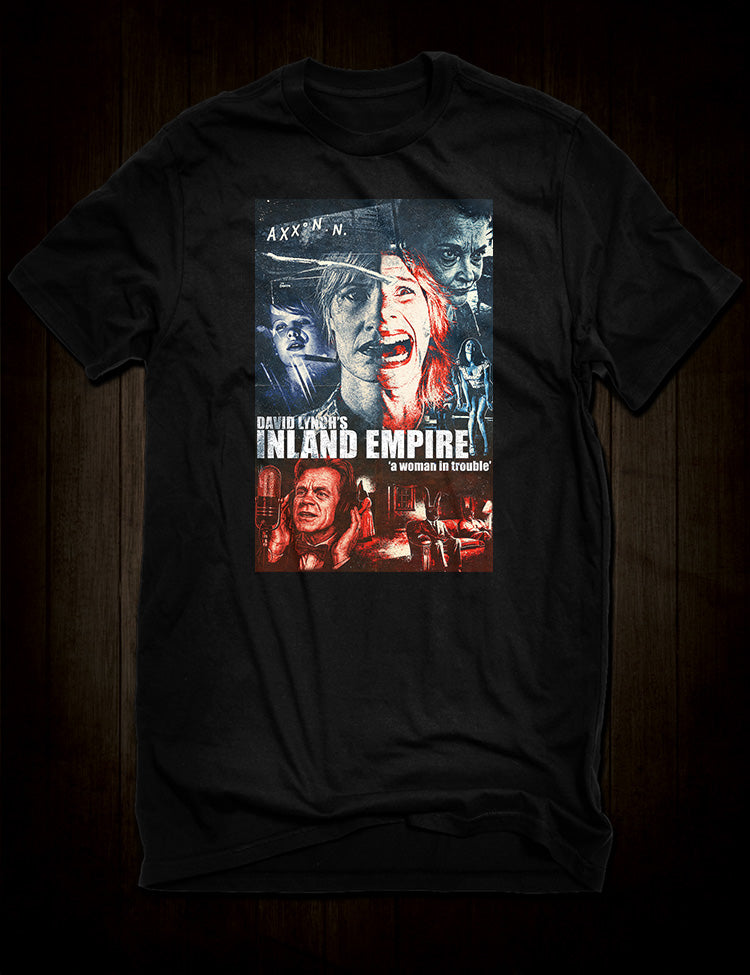
Inland Empire Poster T-Shirt
For Lynch fans drawn to the harsher, stranger digital maze, see the Inland Empire T-Shirt
What Are the Main Themes in David Lynch's Films?
How Does Lynch Use Small-Town America?
Lynch often uses small-town America as a split image. On one side: diners, lawns, high-school rituals, police stations, neighbourly manners, coffee and pie. On the other: violence, secrecy, exploitation, addiction, abuse and supernatural dread.
This contrast is not just cynicism. Lynch is fascinated by beauty and horror occupying the same frame. The flowers are real. So are the insects beneath them.
How Does Lynch Use Hollywood?
In films such as Mulholland Drive and Inland Empire, Hollywood becomes a system of dreams that can consume the dreamer. Auditions, studios, directors, actresses, scripts and performances become unstable. A role can become a trap. A fantasy can become a second identity. A dream of fame can become a private apocalypse.
How Does Lynch Use Doubles and Split Identities?
Doubles appear throughout Lynch’s work because identity is rarely stable in his universe. Characters become other people, meet versions of themselves, project fantasies onto others or discover that the self they trusted was a fragile invention.
This is especially important in Lost Highway, Mulholland Drive, Inland Empire and Twin Peaks: The Return. The double is not just a spooky duplicate. It is the self under pressure.
How Does Lynch Use Sound?
Sound is one of Lynch’s most important storytelling tools. Industrial drones, electrical buzzes, nightclub songs, silence, reversed speech and sudden bursts of noise all create meaning before dialogue can explain it.
In Lynch, sound often tells you what kind of space you are really in. A room may look ordinary, but if it hums like a transformer in a nightmare, the viewer knows something has gone wrong.
How Does Lynch Use Women in Trouble?
Many Lynch stories centre on women who are watched, desired, threatened, doubled, idealized or misunderstood. This can be troubling, and it should be discussed carefully. At his strongest, Lynch exposes the cruelty of systems that turn women into images: the dead girl, the starlet, the singer, the victim, the fantasy object, the muse.
Laura Palmer, Dorothy Vallens, Diane Selwyn, Betty Elms, Nikki Grace and other Lynch women are surrounded by projection. The drama often comes from the gap between the image others consume and the pain the person actually carries.
What Do Common David Lynch Symbols Mean?
The table below gives quick, snippet-friendly explanations of recurring Lynch images. These are not rigid definitions. Lynch symbols work best when understood as emotional patterns that change slightly depending on the film.
| Symbol or Motif | Where It Appears | Common Meaning |
|---|---|---|
| Red curtains | Twin Peaks, dream spaces, stage-like rooms | A threshold between reality, performance, dream and spiritual judgment. |
| Owls | Twin Peaks | Hidden watchers, disguised forces and the idea that nature may conceal supernatural meaning. |
| Highways | Lost Highway, Mulholland Drive, road imagery across Lynch | Escape, identity drift, loneliness and the illusion of forward motion. |
| Blue objects | Blue Velvet, Mulholland Drive | Mystery, erotic danger, hidden truth, melancholy and passage into another layer of reality. |
| Electricity | Twin Peaks, Fire Walk With Me, The Return | A signal path for supernatural forces, communication, possession and unstable reality. |
| Insects | Blue Velvet, Twin Peaks: The Return | Rot under beauty, infestation, corruption and the biological horror beneath polished surfaces. |
| Nightclubs and stages | Blue Velvet, Mulholland Drive, Twin Peaks | Performance, illusion, confession and the strange truth of artificial emotion. |
| Doubles | Lost Highway, Mulholland Drive, Inland Empire, Twin Peaks | Split identity, guilt, fantasy selves and the unstable boundary between person and role. |
| Industrial noise | Eraserhead, Inland Empire, Twin Peaks | Anxiety, dehumanization, machinery, urban dread and reality vibrating at the wrong frequency. |
| Coffee and diners | Twin Peaks, wider Lynch persona | Comfort, ritual, Americana and the fragile warmth of ordinary life surrounded by darkness. |
What Is the Best Order to Watch David Lynch Movies?
If you are new to David Lynch, the best viewing order depends on how deep into the dream you want to go. For a balanced route, start with Blue Velvet, then watch Twin Peaks, Twin Peaks: Fire Walk With Me, Lost Highway, Mulholland Drive, Eraserhead and Inland Empire.
What Is the Easiest David Lynch Film to Start With?
Blue Velvet is often the strongest entry point because it contains many core Lynch elements while still following a relatively clear mystery structure. It has suburbia, noir, voyeurism, music, violence, comedy and dread, all without requiring the viewer to immediately surrender to full dream fragmentation.
Should You Watch Twin Peaks Before Fire Walk With Me?
Yes. For most viewers, Twin Peaks: Fire Walk With Me works best after watching the original television series. The film is a prequel in story time, but it depends heavily on the emotional, symbolic and supernatural world built by the series.
Should You Try to Solve Every David Lynch Film?
No. It is useful to interpret Lynch, but not useful to flatten him. His films reward analysis, but they also depend on mystery, rhythm, sound, performance and emotional contradiction. The best approach is to ask what each image does, not only what it “stands for.”
David Lynch Movies Explained: Frequently Asked Questions
What is the simplest explanation of David Lynch's style?
David Lynch’s style combines surrealism, noir, horror, melodrama, dark comedy and dream logic to reveal hidden emotional truths beneath ordinary life. His films often begin in familiar places, then expose the fear, desire, violence or mystery underneath.
What is the meaning of Twin Peaks?
Twin Peaks is about the darkness hidden beneath a seemingly wholesome town. Its symbols, including owls, red curtains, the Black Lodge and Laura Palmer’s photograph, explore grief, denial, abuse, spiritual danger and the failure of a community to confront evil.
What is the meaning of Mulholland Drive?
Mulholland Drive is often interpreted as a Hollywood dream collapsing into guilt and reality. Betty represents an idealized fantasy of success and love, while Diane represents the wounded self behind that fantasy.
Why are David Lynch films hard to understand?
Lynch films are hard to understand because they do not rely only on linear plot. They use dream logic, sound, symbols, repeated images and emotional association. They are meant to be felt and interpreted, not simply decoded like riddles.
What does the Red Room symbolize?
The Red Room in Twin Peaks symbolizes a threshold between reality, dream, performance and supernatural judgment. Its curtains, strange speech and impossible space make it feel like both a theatre and a spiritual waiting room.
What does the phrase “The owls are not what they seem” mean?
The phrase means that appearances are deceptive. In Twin Peaks, owls suggest hidden forces watching from the woods, and the line reflects the show’s larger idea that ordinary surfaces often conceal darker truths.
Where Can You Find David Lynch-Inspired T-Shirts?
If Lynch’s imagery has followed you out of the cinema and into your wardrobe, Hellwood Outfitters has a dedicated David Lynch T-Shirt Collection built for fans of surreal cinema, Twin Peaks, Blue Velvet, Lost Highway, Mulholland Drive, Inland Empire and the stranger corners of cult film history.
These are unofficial, original Hellwood designs for people who like their pop culture with a little static in the wires, a little velvet in the dark, and a road that refuses to end where it should.
Lynch's Blue Velvet T-Shirt
A design inspired by Lynch’s suburban noir nightmare, where white fences, nightclub songs and criminal darkness meet.
£20.00 GBP
Lost Highway T-Shirt
A cult neo-noir design for fans of Fred Madison, identity collapse, night roads and impossible videotapes.
£20.00 GBP
Mulholland Drive Poster T-Shirt
A tribute to Lynch’s Hollywood dream-maze of identity, desire, performance and shattered illusion.
£20.00 GBP
Twin Peaks - The Owls Are Not What They Seem T-Shirt
A Twin Peaks-inspired design built around one of the most haunting symbolic lines in cult television.
£20.00 GBP
Twin Peaks: Fire Walk With Me T-Shirt
A design inspired by Lynch’s darkest journey into Laura Palmer’s story and the spiritual horror of Twin Peaks.
£20.00 GBP
Inland Empire T-Shirt
A design for the brave few who followed Lynch deep into the digital maze and came back changed.
£20.00 GBP
Why Does David Lynch's Imagery Still Matter?
David Lynch’s imagery lasts because it refuses to become safe. The red curtains still look like a warning. The highway still feels endless. The diner still feels warm until the shadow behind it moves. The blue box still waits to be opened. The ear in the grass still listens.
His films endure because they understand that the strangest images are often the most honest ones. They do not explain the dream away. They ask why the dream was needed.
For more strange roads, velvet rooms and cult cinema artefacts, visit the Hellwood Outfitters David Lynch T-Shirt Collection.