

D. B. Cooper: How a $20 Airline Ticket Created America’s Perfect Unsolved Crime
dAt Portland International Airport on 24 November 1971, a middle-aged man in a dark business suit paid $18.52 in cash for a one-way ticket to Seattle.
He gave his name as Dan Cooper.
Several hours later, the passengers were safe, the airline was $200,000 poorer and Cooper had apparently parachuted from the rear of a Boeing 727 into a stormy Pacific Northwest night.
Nobody has conclusively seen him since.
The D. B. Cooper hijacking has survived because it contains almost everything an unsolved mystery requires: an audacious crime, an anonymous stranger, physical evidence, contradictory clues and an ending that simply stops.
It even acquired the wrong name.
The Passenger Called Dan Cooper
Cooper boarded Northwest Orient Flight 305 from Portland to Seattle carrying a briefcase. Once airborne, he handed flight attendant Florence Schaffner a note indicating that he had a bomb.
His demands were precise: $200,000 in twenty-dollar bills and four parachutes.
When the aircraft landed at Seattle-Tacoma Airport, the ransom and parachutes were delivered. Cooper released the 36 passengers and two crew members, keeping the flight crew aboard while the aircraft was refuelled.
He then ordered the Boeing 727 south towards Mexico City, specifying conditions that included low altitude, reduced speed and the rear stairs lowered.
Somewhere between Seattle and Reno, shortly after 8 p.m., Cooper vanished through those stairs carrying the money.
The FBI never established where he landed, whether he survived or who he really was.
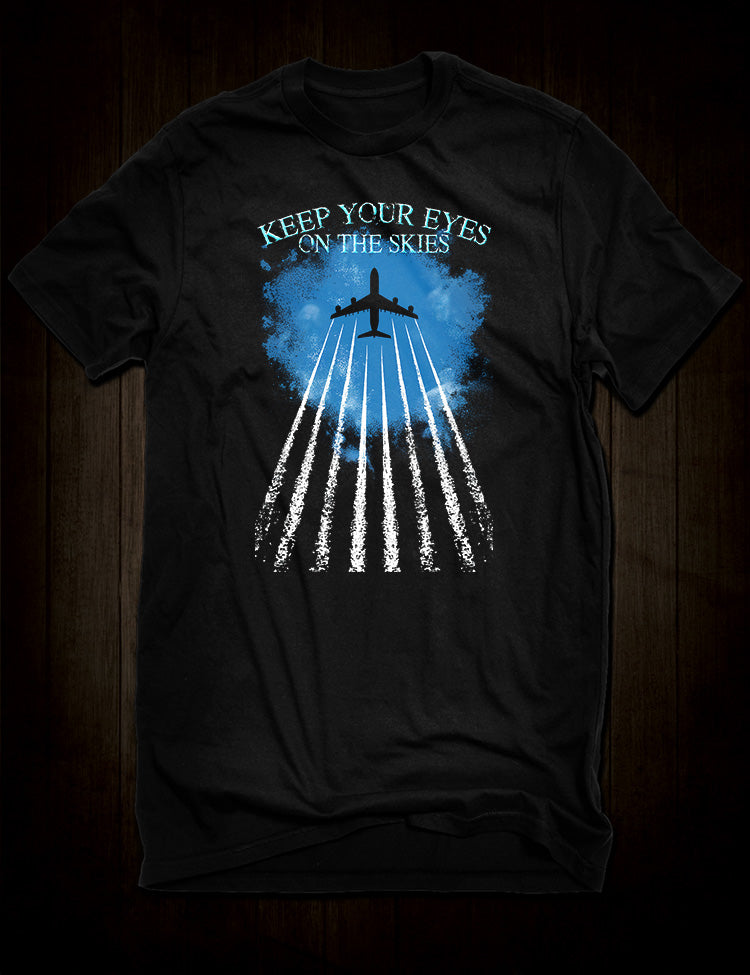
Hellwood's D B Cooper T-Shirt draws on the composite face that subsequently became one of America's most recognisable portraits of a man nobody could identify.

How Dan Became D. B.
One of the case's strangest details arrived almost immediately.
The hijacker never called himself D. B. Cooper.
During the early investigation, authorities questioned an Oregon man named D. B. Cooper who was quickly eliminated. A press misunderstanding attached those initials to the still-unidentified hijacker, and the mistake proved impossible to dislodge.
The FBI called the investigation NORJAK, short for Northwest hijacking.
Agents interviewed hundreds of people, pursued suspects across the country and examined physical evidence recovered from the aircraft. Cooper had left behind a black clip-on tie, while witnesses supplied the descriptions used for a succession of FBI composite sketches.
Yet the investigation kept returning to the same irritating fact.
There was plenty of evidence that the crime happened and remarkably little explaining who committed it.
The Money Comes Back
For nine years, even the ransom seemed to have disappeared.
Then, in February 1980, eight-year-old Brian Ingram was digging in the sand at Tena Bar on the Columbia River when he discovered deteriorating bundles of twenty-dollar bills.
The serial numbers matched Cooper's ransom.
It was a spectacular clue that solved almost nothing.
The discovery proved that at least $5,800 of the ransom had reached the Columbia River area, but precisely how and when remained uncertain. It did not establish where Cooper landed. It did not identify him. It did not even prove whether he survived his jump.

America Builds the Perfect Fugitive
The absence of an answer created room for hundreds of them.
Suspects have included military veterans, parachutists, engineers, criminals and apparently respectable citizens whose biographies acquire a suspicious glow once placed beside an unsolved case. New candidates continue to appear whenever documents, family stories or forgotten objects surface.
Some theories argue Cooper was an experienced parachutist. Others point out that jumping at night into bad weather over unknown terrain was hardly the behaviour of someone determined to demonstrate professional technique.
The uncertainty is precisely what turned a serious federal crime into folklore.
Cooper became the criminal equivalent of an empty silhouette. He could be a master planner, desperate amateur, dead man in the wilderness or ordinary citizen who somehow walked back into normal life.
That mixture of documented history and unresolved American mythology places the case naturally alongside Hellwood's American History collection, True Crime collection and Twisted Americana collection.
The Man Missing From His Own Story
In July 2016, after 45 years, the FBI redirected the resources devoted to actively investigating NORJAK. The surviving evidence was preserved, and genuinely significant new physical evidence could still command attention.
That was not the same thing as solving the case.
The ticket survives. The sketches survive. Some ransom money survives. Thousands of pages of investigation survive.
Cooper does not.
Perhaps he died in the wilderness before the search even began. Perhaps he escaped and spent decades watching strangers confidently explain who he was.
Either way, the most extraordinary thing about D. B. Cooper remains remarkably simple.
We know exactly when he disappeared.
We still do not know who disappeared.

D B COOPER T-SHIRT
A Hellwood tribute to the unidentified skyjacker who boarded Flight 305 as Dan Cooper, collected $200,000 and disappeared into the Pacific Northwest night — leaving behind one of America's great unsolved mysteries.