





Antonin Artaud’s Theatre of Cruelty: What the Famous Phrase Actually Meant
Few theatrical ideas have suffered quite as much from having an excellent name as Antonin Artaud’s Theatre of Cruelty.
The phrase suggests torture chambers, blood-soaked stages and actors doing alarming things with kitchen implements. What Artaud proposed in 1930s Paris was more complicated. He wanted theatre to stop behaving like illustrated literature and become a physical assault on complacency: sound, light, movement, gesture and space working directly upon the spectator.
Hellwood’s Antonin Artaud T-Shirt celebrates the writer behind that revolutionary idea. Nearly ninety years after his theories appeared in The Theatre and Its Double, the Theatre of Cruelty remains one of modern performance’s most famous — and frequently misunderstood — concepts.
Cruelty Without the Chainsaw
Artaud did not use “cruelty” simply as another word for violence.
As the Routledge Encyclopedia of Modernism explains, the term suggested rigour and discipline as well as Artaud’s conviction that cruelty was an unavoidable condition of existence. Theatre should confront that reality rather than provide audiences with another comfortable evening watching fictional people discuss their problems in a tastefully furnished room.
Artaud objected particularly to theatre dominated by dialogue. Words had become too respectable. The playwright wrote them, actors recited them and audiences sat safely beyond the footlights interpreting their meaning.
He wanted to interfere with that arrangement.

A Theatre That Attacks the Senses
In Artaud’s imagined theatre, the spectator would no longer sit comfortably facing a conventional stage. Performance would surround the audience. Sound might arrive from unexpected directions. Light could become harsh and disorientating. Gesture, rhythm, cries, music and physical movement would communicate alongside — and sometimes instead of — conventional speech.
The ambition was almost architectural. Everything present in the performance became part of a theatrical language.
Artaud developed these ideas between roughly 1931 and 1935. His encounter with Balinese dance at the 1931 Paris Colonial Exhibition became particularly important to his thinking. He was fascinated by a performance tradition in which gesture, costume, rhythm and movement seemed to possess expressive force independently of realistic dialogue.
There are obvious complications in a European avant-garde artist encountering Asian performance through a colonial exhibition and interpreting it for his own purposes. Artaud’s response tells us at least as much about his dissatisfaction with European theatre as it does about Balinese performance itself.

The Plague as a Model for Performance
One of Artaud’s most memorable comparisons was between theatre and plague.
He was not proposing that box-office success required infecting the stalls. The plague interested him as an image of social disruption: something that tears through normal behaviour and exposes what civilisation has kept hidden.
Theatre, he believed, ought to perform a comparable function.
Instead of reassuring spectators, it should disturb them. Instead of reproducing ordinary reality, it should reveal the violence, fear, desire and irrational forces underneath it. Performance became something closer to ritual or exorcism than conventional storytelling.
This helps explain why the Theatre of Cruelty proved much more influential as an idea than as a practical theatrical system. Artaud offered a provocation rather than an easily reproducible instruction manual.
The Book That Outlived the Theatre
Artaud gathered his major theatrical writings into Le Théâtre et son Double — The Theatre and Its Double — published in 1938. It included the Theatre of Cruelty manifestos, his famous essay on theatre and plague, and his reflections on Balinese performance.
By then his own attempts to realise the theory on stage had achieved little commercial success. That hardly mattered in the long run. The book travelled much further than his productions ever did.
Its insistence that performance could overwhelm an audience through bodies, sound, space and sensation fed into experimental theatre, performance art and later forms of confrontational popular culture. Artaud’s importance lies partly in giving artists permission to regard discomfort as artistically useful.
Explore more literary outsiders in Hellwood’s Famous Writers T-Shirts, Cult & Classic Novel T-Shirts and wider Literary T-Shirts.
The Theatre of Cruelty was never really an invitation to put cruelty onstage. It was an attempt to make theatre dangerous again — not because the audience might be harmed, but because it might leave thinking differently from when it arrived.
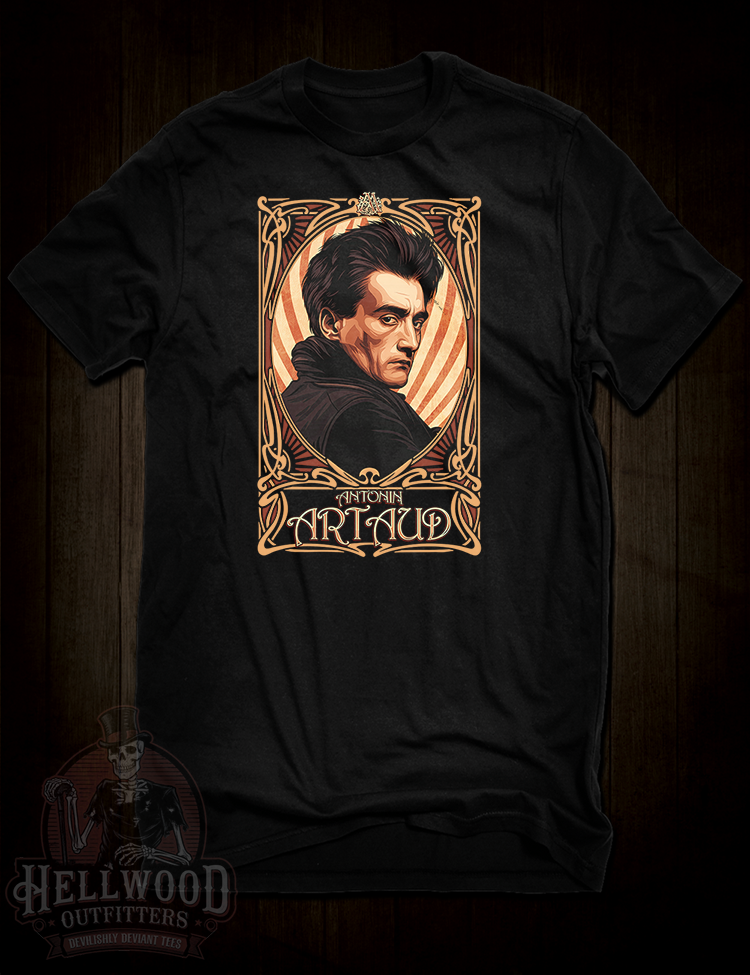
ANTONIN ARTAUD T-SHIRT
A Hellwood tribute to the French poet, actor and theatrical revolutionary who wanted performance to escape the page and speak directly to the nerves.